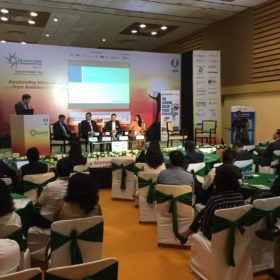
Better bifacial adoption, catalyzing innovation focus of Future PV Roundtable at REI
pv magazine’s Future PV Roundtable, held at the 2018 Renewable Energy India (REI) Expo in Greater Noida, discussed how India can better adopt bifacial solar cell and module technology – the future of power generation. Prominent industry speakers also put forth their views on how standards can catalyze solar innovation for India-specific challenges, and on PV materials and components for enhanced module efficiency and recycling.
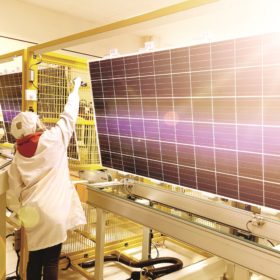
Canadian Solar unveils new 400+ Watt bifacial poly PERC black silicon module
The Chinese-Canadian module manufacturer says its P4-based BiHiKu panel, for large commercial and utility-scale solar projects, is able to provide up to 30 per cent additional output from the rear side.

Australian researchers use nanocrystals to harvest solar energy for clean fuels
Researchers at Western Australia’s Curtin University have developed a low-cost and environmentally friendly method to capture solar power and produce clean fuels such as hydrogen.
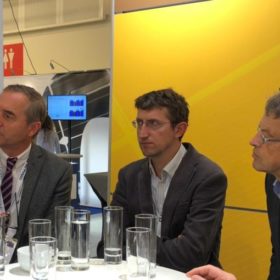
Manufacturers and research institutes form alliance in Europe
The European Solar Manufacturing Council has been launched at EU PVSEC in Brussels. Participating research institutes, mechanical engineers, material and PV manufacturers stress the importance of having big solar manufacturers in Europe.
Heraeus to partner with Ulbrich Solar Technologies for SCR production
The new Selectively Coated Ribbons (SCR) technology could improve yields by 2.2 Watts on module level, says the manufacturer. The new ribbons can also be used with existing equipment, omitting the need for manufacturers to invest in new production outlay, at a time when profit margins in module manufacturing are squeezed.
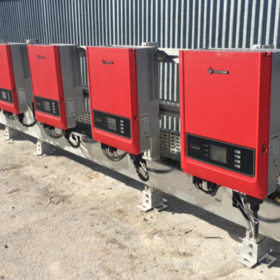
Interview: GoodWe talks IPOs, policy changes and tripling production capacity
In an interview with pv magazine, vice president of GoodWe, Ron Shen, talks about the company’s plans for Germany, Spain, Africa and India, in addition to its goal to triple production capacity to 15 GW in China. He also discusses the effect of China’s 31/5 policy change, and plans for an initial public offering (IPO).

Battery maker Lithium Werks to open research campus in Twente
The Dutch company provides lithium iron phosphate batteries and employs artificial intelligence solutions for mobility-as-a-service applications. It aims to develop its technology further with the help of the University of Twente.

EV charging companies to ramp up installations
The market for EVs is experiencing robust uptake worldwide with companies, governments and municipalities implementing policies to drive development. EVN and EVBox announced plans for expansion this week, and the UK government is also pouring investment subsidies into the electric vehicle market.

Challenges and solutions for anti-LID treatment
In PERC modules, both light and elevated temperature induced degradation (LeTID) and light induced degradation (LID) must be mitigated. What makes this tricky, however, is that the mitigation process of the first, counteracts that of the second, says Karin Krauß, R&D project manager, Rehm Thermal Systems. At the pv magazine Roundtable in Taipei next week, she will discuss possible solutions with cell and module manufacturers, and EPCs.

Solar, wind power could increase rainfall in the Sahara
The Sahara Desert, and the Sahel region, could be set to take advantage of large-scale wind and solar power projects covering huge surfaces.
