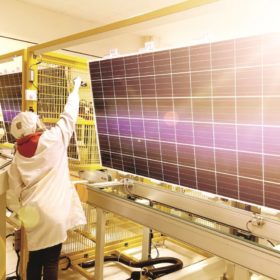
Chinese PV Industry Brief: Another manufacturer, Zhonghuan, reduces PV wafer prices
The solar manufacturer has lowered the prices of its PV wafers by up to 12.5%. In other news, Haiyuan Material (HYM) has begun deploying production lines at its 5 GW heterojunction PV module factory.
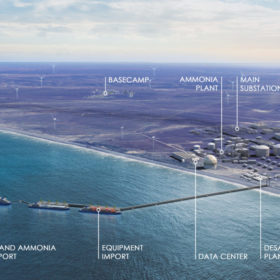
The Hydrogen Stream: 8 GW green hydrogen project announced in Chile
Meanwhile, on the Iberian Peninsula, H2 Green Steel (H2GS) and Iberdrola plan to establish a 1 GW green hydrogen production facility, and Acciona and Plug Power want to deploy green hydrogen facilities across Spain and Portugal.
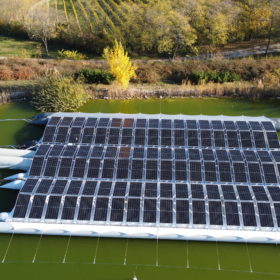
Puffer fish inspired floating PV structure
With a new system for floating photovoltaic power plants, engineers from Germany want to make the application cheaper, higher-yielding, and safer. The result is somewhat reminiscent of a pufferfish, which also gave the system its name.

TSEC plans to raise solar cell, module production capacity to 1.5 GW
The Taiwanese solar manufacturer has raised US$22 million through a private placement of shares and will use the funds to support its solar capacity expansion plans.
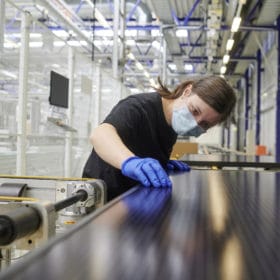
Covid-19 forces Meyer Burger to reduce solar module output, increase panel prices for 2022
An above-average employee sickness absence is forcing the Switzerland-based solar panel manufacturer to slow down production until the end of January. Meyer Burger has also informed customers that the prices for its solar modules will rise in the coming year.

Bahrain issues two tenders for 7.5 MW of PV capacity
Through the two procurement exercises, Bahrain’s Sustainable Energy Authority (SEA) wants to deploy solar plants at the Ministry of Labour & Social Development and the Ministry of Education.
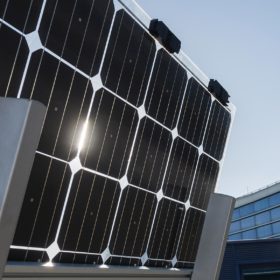
2021 and beyond: European solar manufacturing must shine again
As 2021 ends, we enter a period of reflection and preparation. The ongoing pandemic has brought supply chain disruption, while the increasingly severe effects of the climate crisis loom over us. This winter, Europeans are struggling through unprecedented energy costs, driven by extremely high global gas prices. A year of difficulties has shown that Europe, more than ever, must accelerate the deployment of renewables to provide our economy with reliable, low-cost, and clean energy.
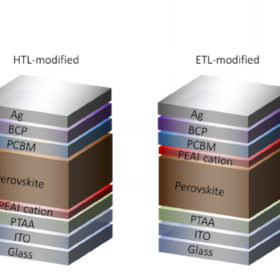
Inverted perovskite solar cell with 23.7% efficiency
A German-Italian research team has designed an inverted perovskite solar cell with a short-circuit current of 1.184 V and a remarkable fill factor of 85%. The device was built by modifying its interfaces with large organic cations.

Narrowing down a million molecules for the optimal flow battery
Scientists in the United States turned to artificial intelligence to speed up their search for new materials for use in a flow battery. The group developed a machine learning algorithm that could search a dataset of potential materials and identify those with the ideal balance of different characteristics that make it suitable for use in a flow batteries. The group says its algorithm could be applied to other battery technologies, and even in other fields.
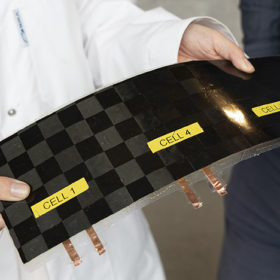
Massless battery for applications in vehicle-integrated solar
Swedish scientists have developed a structural battery that purportedly offers “massless” storage, as its weight vanishes when it becomes part of the load-bearing structure. The device has an energy density of 24 Wh/kg and is designed for easy integration into solar-powered vehicles.
