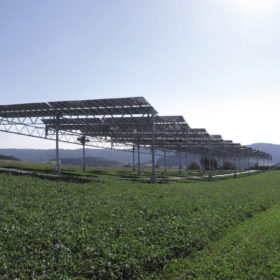
The weekend read: Solar’s flexibility can be agriculture’s gain
Both solar and the farming industry are beginning to see potential in the combined use of land for food production and energy generation. And as innovators begin to experiment with different forms, it’s becoming clear that in most cases it is solar that will have to bend to the needs of agriculture, and not the other way around, to ensure a positive outcome.

Northvolt plans to expand gigafactory in Poland
The Northvolt manufacturing facility in Gdansk should become Europe’s largest factory for energy storage solutions. The production is scheduled to begin in 2022 with an annual capacity of 5 GWh. The company wants to expand it to 12 GWh.
Chinese PV Industry Brief: New glass capacity and a 20 GW wafer order
Flat Glass has activated two new glass furnaces that will bring its total production capacity to 8,600 MT per day. JinkoSolar has secured 20 GW of orders for its 182mm-wafer-based modules.
The best materials for carrier multiplication in solar cells
Researchers in the Netherlands have sought to identify all those semiconductor materials that may make the application of carrier multiplication in photovoltaics much more than a mere suggestion. According to them, the bandgap of the materials should be between 0.6–1.0 electronvolt (eV), which would result in maximum theoretical efficiency of around 44%. 2D and bulk materials were indicated as the most promising with near-ideal carrier multiplication.

France launches 700 MW tender for large-scale PV
Solar project developers in France will have until June 25, 2021, to submit their bids. Under new rules, the selected PV projects must use modules manufactured with a low carbon footprint.
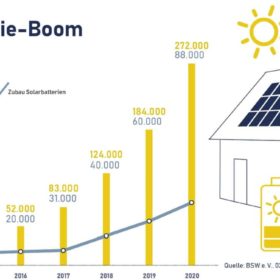
Germany has 270,000 residential batteries linked to PV
Around 88,000 energy storage systems linked to rooftop PV were installed last year in the country, which supports residential batteries through a dedicated scheme.

Italian solar energy community benefits its members with up to €140/MWh in annual savings
The Italian regulation about renewable energy communities entered into force last December. Market operators are now working to establish renewable energy communities (RECs) in Italy. Ènostra coop is currently completing the feasibility study for the development of two RECs in Sardinia. pv magazine spoke with project manager Christian Bartolomeo.

Croatia announces 400 MW renewables auction
The procurement exercise will be the country’s second attempt to support large-scale solar and wind. The first 88 MW auction launched last year saw the allocation of just 25.5 MW. Solar secured 13.4 MW at an average price of $0.093/kWh. Selected PV projects range in size from 50 to 500 kW.
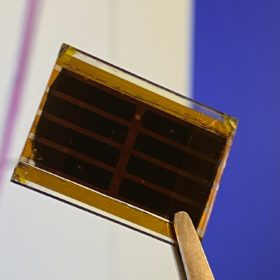
Perovskite solar cell with 21% efficiency includes tech to prevent lead leaks
U.K. scientists have used mesoporous scaffolds based on hydroxyapatite nanoparticles – blended with titanium oxide nanoparticles – to create a mechanism that prevents lead leakage in perovskite solar cells. They claim the method captures lead ions in leaks, while also increasing cell efficiency.
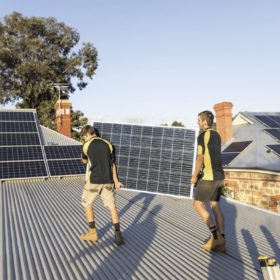
Australian regulator credits renewables for electricity price decline
The Australian Energy Regulator says that investments in renewables and rooftop solar uptake are driving the ongoing decline in electricity prices.
