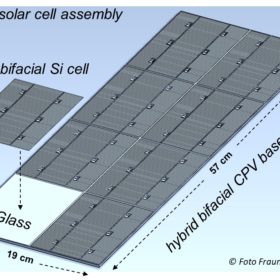
Fraunhofer ISE researchers develop bifacial hybrid HCPV module with output of 326 W/m2
The EyeCon module has a hybrid power output of 326 W/m² or a bifacial efficiency of 28%, calculated with the available global plus backside irradiance. According to the research team, the silicon cell generates between 23 and 42 W/m² of additional power when the diffuse irradiance component increases from 8 to 30%.

21-year solar PPA for three French airports
The airports of Paris-Charles-de-Gaulle, Orly and Le Bourget will be provided with solar power by French solar company Urbasolar and energy provider GazelEnergie. The PV plants related to the contract are now in development and will begin delivering power in 2021.
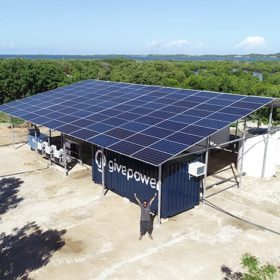
A new solar desalination system to address water scarcity
The GivePower non-profit founded by Tesla subsidiary SolarCity is supplying solar-powered desalination systems to some of the world’s neediest communities, backed by Tesla’s Powerwall battery technology.
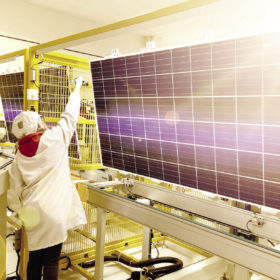
Canadian Solar signs 1.2 GW supply agreement with Lightsource BP
The Chinese-Canadian module manufacturer will supply panels to the U.K.-based developer over several years. The modules are destined for projects in the United States and Australia.
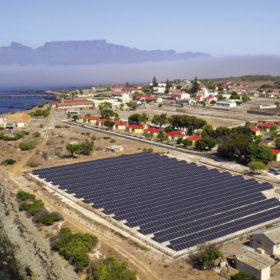
ABB’s electrification business posts strong returns after inverter divestment
The Swiss-headquartered technology corporation is restructuring, stirring up the figures. That effect was amplified by acquisitions and sell-offs last year with ABB announcing in July it would hand over its inverter business to Italian company Fimer.
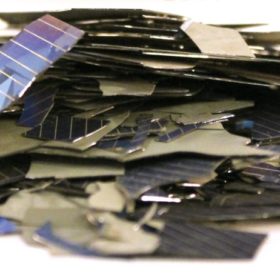
Italian PV panels sent for recycling were instead smuggled to Syria and Africa
Illegally re-badged panels were sold on to Senegal, Burkina Faso, Nigeria, Morocco, Mauritania, Turkey and even Syria. Italian authorities found 60 tons of panels which will be examined.

India commissioned 7,592 MW of new renewables in first nine months of the fiscal year
Capacity additions for the current fiscal year are set to exceed the previous accounting period’s 8,532 MW. With $5.69 billion invested in clean energy in the last fiscal year, spending in the first nine months of 2019-20 has been estimated at $5.16 billion.

Dutch grid operator expects up to 34 GW of solar by 2030
Under Tennet’s most optimistic outlook, solar generation capacity could more than double the volume of wind farms by the end of the decade, provided the Netherlands goes above and beyond Paris Agreement climate change requirements.
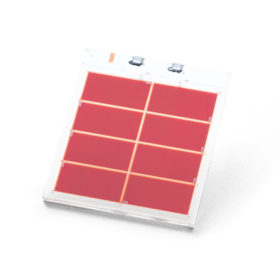
Ricoh launches solar cell for indoor applications
The Japanese electronics company has produced a solid-state, dye-sensitized solar cell for integration into sensors and consumer electronics. The company says the device can generate electricity from indoor light.

Coronavirus to have limited impact on Chinese polysilicon industry
Analyst Johannes Bernreuter says most of China’s polysilicon production capacity is in regions away from the center of the coronavirus outbreak. He added, however, 27% of the nation’s 510,000-ton annual polysilicon capacity could be affected.
