
US launches national security probe into polysilicon imports
The US Department of Commerce (DoC) says it will investigate the potential for export restrictions by foreign countries, as well as their ability to “weaponize” their control over supplies of polysilicon.
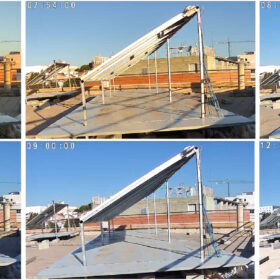
Precise backside irradiance modeling for bifacial PV is often unnecessary
A European research group has developed a new “empirical” method for measuring the backside irradiance of bifacial PV system. The proposed approach was tested across several European locations and it was found to enable annual performance calculations with a fixed backside irradiance share value.

US renewable energy rollout slows amid local opposition, zoning laws
Residents and local restrictions are delaying and blocking renewable energy projects in the United States at an accelerated rate, according to a study from Columbia University.
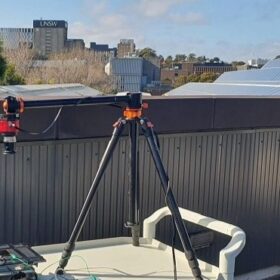
Using photoluminescence, implied open-circuit voltage imaging for perovskite solar cell field testing
To evaluate the outdoor performance and stability of perovskite solar cells using contactless and noninvasive methods, an Australian and Chinese research team found a way to use photoluminescence imaging as well as demonstrating a proof of concept for implied open-circuit voltage (iVOC) imaging. Their research relied on cost-effective equipment that operates under direct sunlight.
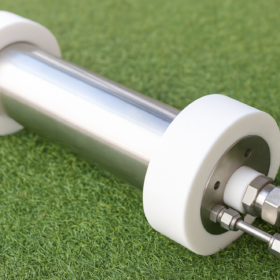
Australian company debuts hybrid electrolyzer to cut green H2 costs
Cavendish Renewable Technologies (CRT) has launched an advanced hybrid electrolysis platform that blends the strengths of solid oxide and alkaline technologies and addresses the pain points of green hydrogen adoption.

SAEL Industries to build 5 GW solar cell and module plant in India
SAEL Industries Ltd. will invest INR 82 billion ($955 million) to build a 5 GW solar cell and module plant in India. The facility will raise its total manufacturing capacity to 8.5 GW.
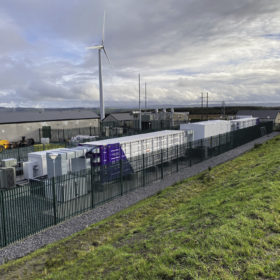
Worldwide battery storage installations up 54% in first half of 2025, June sets monthly record
New data from Rho Motion shows that over half of June’s installations were concentrated in China, maintaining the country’s dominance in the global energy storage market.

Foundations for peak production in utility-scale solar
Mitigating sub-surface risks long before the construction phase is one of the best ways to prevent cost escalation and delays during construction, while also setting solar arrays up for maximum productivity over their lifespan.
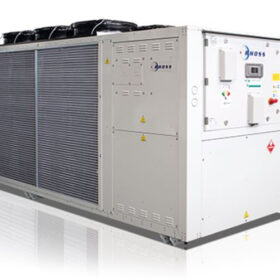
Rhoss launches reversible heat pumps
Conceived for industrial applications, the novel heat pumps can reportedly deliver hot water at 65 C from -10 C up to 35 C of external air, and hot water at 55 C down to -20 C of external air. Their coefficient of performance reaches up to 3.47.

Photovoltaics for cargo ships
Wattlab has installed a PV system capable of delivering up to 35 kW to a cargo ship’s high-voltage propulsion system, allowing it to temporarily replace one of four diesel generators under optimal conditions.
