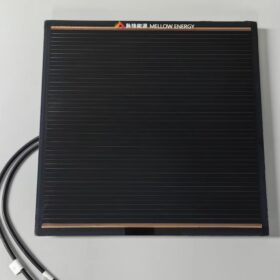
Perovskite solar module based on new interconnection tech achieves 21.37% efficiency
Chinese solar perovskite specialist Mellow Energy and the Jinan University developed a new manufacturing process for perovskite solar modules that enables the formation of a protective layer at the interface between the perovskite absorber and the electron transport layer. This prevents the effusion of volatile components from the perovksite film.
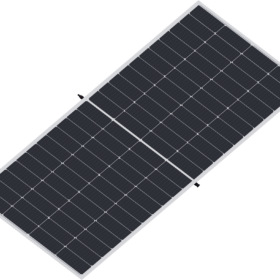
GoodWe releases 335 W BIPV panels with 17.4% efficiency
The panels measure 2,116 mm × 777 mm × 3.5 mm, weigh 5.6 kg/m2, and have a temperature coefficient of -0.35% per degree Celsius.
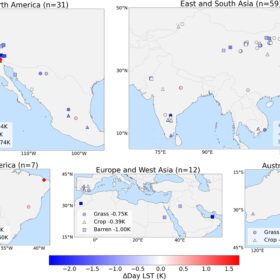
The effect of PV plants on albedo, vegetation, land temperature
Scientists have used remote sensing to analyze the effect solar farms have across 116 sites worldwide. They found that the cooling effect is higher during the daytime, with albedo decreasing by 0.016 for most facilities.
Whale algorithm to integrate rooftop solar with air source heat pumps
Researchers in China have developed an optimized version of the whale optimization algorithm that reportedly indentifies the optimal area ratio of rooftop PV systems and solar collectors used in combination with air source heat pumps. They demonstrated that the installation area of photovoltaic modules and collectors affects both the power side and the thermal side.

Chinese PV Industry Brief: DAS Solar launches IPO
Chinese module maker DAS Solar says it aims to raise $351.7 million through an initial public offering (IPO). It will use the funds to expand its cell and module capacity.
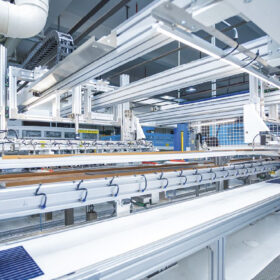
Building bridges between East and West
Italian module manufacturer FuturaSun has big expansion plans in China, with the first phase of a 15 GW silicon cell fab due online in Huai’an in the first quarter of 2024, in addition to 1 GW of module production in Taizhou. Erik Eikelboom, technical adviser to FuturaSun, offers a closer look at the project.

Futurasun starts construction of 2 GW back contact module factory in China
The Italy-based solar module manufacturer said it is progressing with its previously announced transition from module manufacturer to a vertically integrated manufacturer with 12 GW of cell capacity. It also said the project to build a module factory in Italy is going through a “complicated process.”
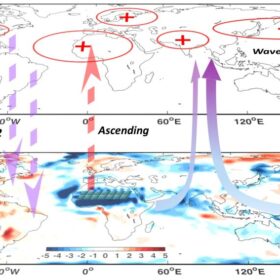
Covering Sahara desert with solar plants may increase cloud cover in surrounding regions
Researchers in China have assessed the impact of using up to 50% of the Sahara desert for the deployment of large scale solar power plants and have found these may impact the global cloud cover through disturbed atmospheric teleconnections. This, in turn, would impact solar power generation itself in North Africa, Southern Europe, the Southern Arabian Peninsula, India, North Asia, and even Eastern Australia.
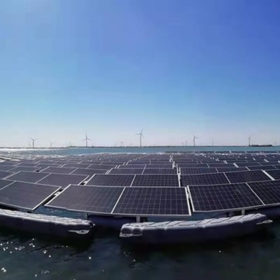
China’s floating PV potential estimated at 862.6 GW
Researchers from China looked at 875 reservoirs in the country and found that the potential annual power output for floating PV technology could reach up to 1,423.8 TWh.
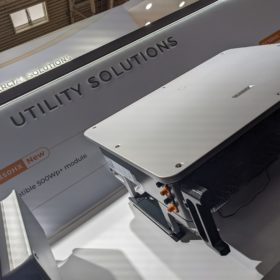
Chinese PV Industry Brief: CHN Energy finalizes 10 GW inverter procurement
CHN Energy has wrapped up its 10 GW PV inverter tender for 2023, with Huawei securing orders for 4.1 GW of string inverters and Sungrow obtaining 1.85 GW.
