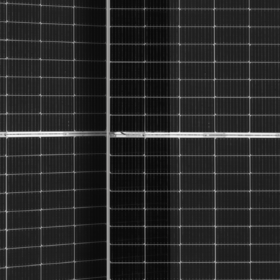
TOPCon vs PERC – a battle between fast learning curves
TOPCon solar modules will gain more market share if their average efficiency, already higher than that of PERC panels, continues to improve, according to Stefan Glunz, PV research chief at Germany’s Fraunhofer Institute for Solar Energy Systems ISE. In an upcoming pv magazine webinar on the potential of TOPCon tech, Glunz will show how to reduce costs and increase efficiency.
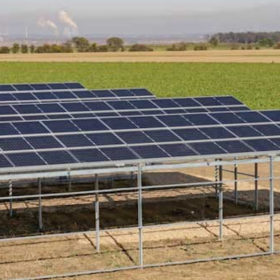
New agrivoltaic system design from Germany
Germany’s Sunfarming is testing the new project design in cooperation with research centers Jülich and the Fraunhofer ISE.
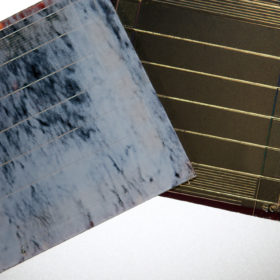
Small-area, colored perovskite BIPV module with 13.9% efficiency
Through a conventional coloring technique for crystalline solar modules, scientists in Germany were able to manufacture a colorized small perovskite solar module in white marble optic displays that maintains up to 88.5% of the efficiency it had before coloring. The device was built with five cells interconnected in series and has a total area of 9cm2.
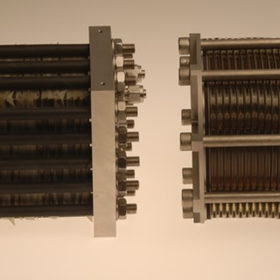
Large scale alkaline electrolyzers may be built at €444/kW in 2030
Researchers at Germany’s Fraunhofer ISE have estimated the costs for both alkaline (AEL) and proton exchange membrane (PEM) electrolyzers and have found that AEL systems have bigger margins for cost reduction. According to their calculations, the costs of a large scale AEL electrolyzer with a capacity of 100MW should drop from €663/kW in 2020 to €444 in 2030.
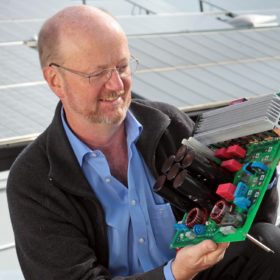
Fraunhofer ISE reaches legal settlements with seven inverter manufacturers who infringed its patent
In 2002, the Fraunhofer ISE patented the HERIC circuit for highly efficient inverters. Since then, the institute says, it has recorded out-of-court settlements in seven patent infringement lawsuits against companies from China, Taiwan and Germany.
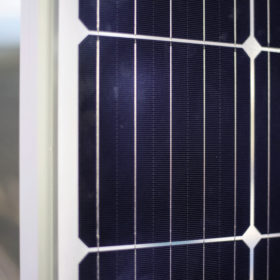
Powering up PERC-perovskite tandem cells
Perovskite-silicon tandem cells offer one of the surest pathways to much higher solar efficiencies, one that has moved close to commercialization in the past few years. Much of the work getting to this stage has naturally focused on developing a viable perovskite top cell. Optimizations to the silicon layer underneath, however, will also be important to the overall device function and efficiency. Scientists in Germany examined five different silicon cell concepts similar to those in mass production today, finding that with a few optimizations these could reach efficiencies up to 30.4%.
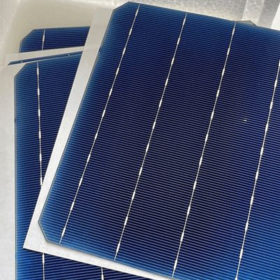
German consortium develops 19.7%-efficient PERC solar cells made of recycled silicon
Led by German research institute Fraunhofer ISE, the consortium has built the solar cells with 100% crystalline silicon recycled from end-of-life photovoltaic panels. The silicon is recycled through a technique conceived by German specialist Reiling GmbH & Co. KG and the Fraunhofer Center for Silicon Photovoltaics CSP.
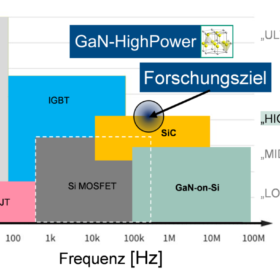
German consortium develops gallium nitride grid-supporting inverters
Researchers from German research institutes and companies are working on applying semiconductors based on gallium nitride (GaN) to string inverters with the aim of enabling cost and weight reduction while maintaining very high efficiency. These devices are expected to support grid operations through faster switching processes.

‘The technology and the capital are available, but the market simply lacks execution capacity’
1Komma5° has acquired a majority stake in Swedish solar installation provider Cellsolar AB. This is the sixth acquisition of the recently founded Cleantech startup which wants to open the installation sector for the capital market in order to allow rapid growth.
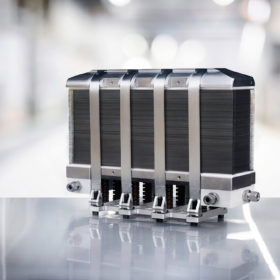
The Hydrogen Stream: Novel fuel cell tech based on liquid-organic hydrogen carrier
Germany’s Schaeffler is developing a hydrogen fuel cell that runs on a liquid organic hydrogen carrier, and Australia’s H2X Global has formed a joint venture with Indian automotive components manufacturer Advik Hi-Tech to manufacture hydrogen fuel cells, generators and vehicles.
