
Green roofs may improve PV system performance by 8%
German solar company Polarstern sees many performance-enhancing effects when photovoltaic systems are combined with green roofs. These are provided by cooling, dust absorption and reflective behavior, which are favored by the plants on the roof.
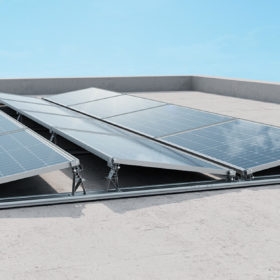
Flat-roof mounting system for modules with lengths of 1,500 to 2,000mm
Designed by German provider IBC Solar, the mounting structure can accommodate modules with lengths from 1,500 to 2,100mm and widths from 980 to 1,150mm. It comes with floor rails with pre-mounted construction protection mats and integrated cable ducts for up to 28 6mm² cables.
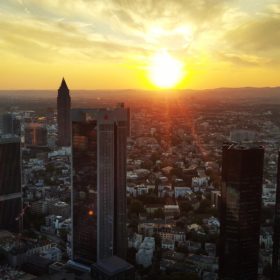
Germany installed another 400 MW of PV in July
In the first seven months of the year, the country deployed 3.2 GW of PV, which compares to 2.8 GW a year earlier.
German researchers want to reduce manufacturing costs for electrolysers by more than 25%
A number of Fraunhofer institutes in Germany want to make green hydrogen more cost-competitive and are working to identify the best and most economical processes for the production of electrolyzers. They intend to build a digital library of future-proof electrolyser manufacturing processes with which the investment costs and even the return on investment can be determined in advance depending on the planned production volume.
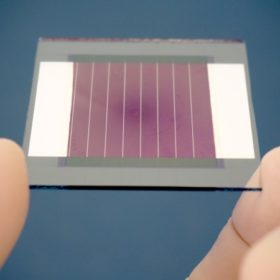
Mini organic solar module with 13.94% efficiency
The panel is based on 14.9%-efficient organic PV cells with a surface of 1.1 cm2 that the same research group unveiled in September 2020. The solar cells were interconnected using laser structuring.
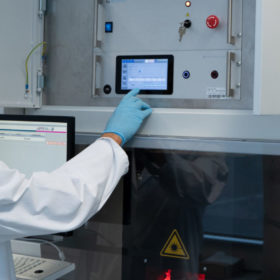
Fraunhofer CSP develops repair process for PERC solar cells
The performance of the solar cell contacts can be improved with laser-assisted current treatment. The process does not damage the solar cells but only optimizes faulty semiconductor-metal contacts.
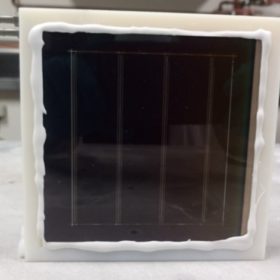
Coupling PV-powered electrochemical water splitting with battery storage
A German research team has developed a photovoltaic-electrochemical device for alkaline water electrolysis that can be linked to battery storage. The proposed system configuration can not only smoothen out the PV power fluctuations and facilitate power coupling, but also improve solar to hydrogen efficiency.
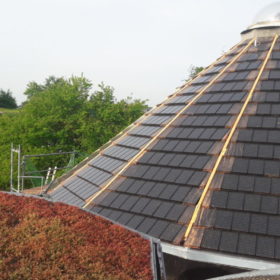
Conical roof equipped with solar tiles
The solar tiles were deployed on a conference center in Glücksburg, Germany. In addition to PV, the building also uses solar thermal energy and biomass to cover heat demand. The power generated by the PV array is utilized entirely for self-consumption.
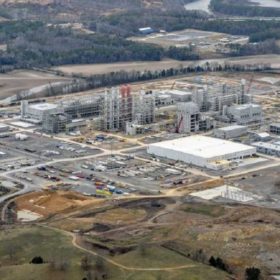
Wacker signs polysilicon supply deal with Jinko
The German company will sell 70,000 tons of its product to the module maker over the course of a five-year contract.
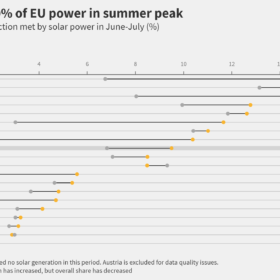
PV covered 10% of EU electricity demand in June and July
According to UK-based consultant Ember, eight EU countries achieved record solar power production during June and July. Germany and the Netherlands were able to cover around 17% of their electricity demand with PV over the period.
