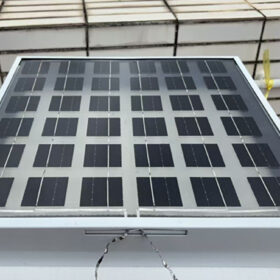
Thermochromic bifacial PV glazing system for reducing building cooling loads
Researchers in Hong Kong Hong Kong fabricated a thermochromic bifacial photovoltaic glazing system prototype that passively regulates solar heat gain while harvesting energy from both sides. Experiments and simulations showed it significantly reduces cooling loads and indoor temperatures while boosting electricity generation.
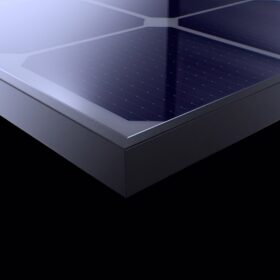
Hong Kong–based startup launches glass-fiber composite solar module frames
Xilia Group has introduced composite frames for solar modules made from glass fiber–reinforced polyurethane. The company says the frames reduce weight, resist corrosion, and eliminate the need for grounding.
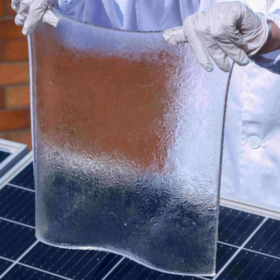
New hydrogel layer tackles solar module hotspots
A team of scientists has developed a novel hydrogel solar panel coating that is reportedly capable of lowering hot spot temperatures by up to 16.2 C, outperforming conventional hydrogels. The hydrogel also demonstrated superior durability and improved power output by up to 13%, according to the research group.
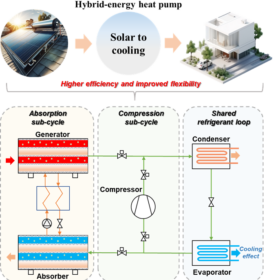
Scientists unveil hybrid-energy heat pump combining absorption and compression cycles
Researchers in Hong Kong have developed a hybrid-energy heat pump that seamlessly combines absorption and compression cycles using crystallization-free ionic liquids, improving efficiency and reliability across varying solar conditions. Simulations in multiple Chinese cities show the system can significantly cut electricity use and cooling costs, making it promising for sustainable building cooling and future commercial scaling.
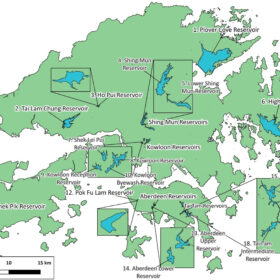
Floating PV could power up to 490,000 households in Hong Kong
Hong Kong has limited land, and researchers have checked how much of the city can be powered if most of its water reservoirs were to be fully or partially covered with floating PV systems. At best, full coverage can supply more than 15% of the city’s total demand, and more than 60% of the residential demand.
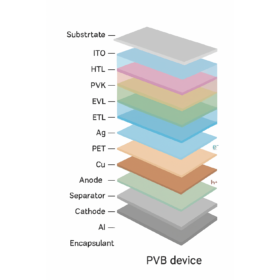
All-perovskite PV-powered battery for portable electronics
Scientists have used a dual-functional, material-sharing strategy with ethyl viologen diiodide to achieve synergistic performance enhancement in PV-powered batteries. The system was reportedly able to power a wearable glucose monitor for 24 hours.
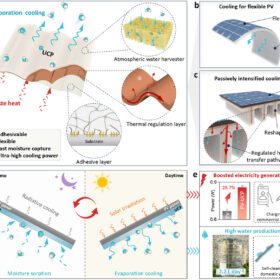
Reducing PV module temperature with ultra-cooling patch
Scientists in Hong Kong have developed a patch that effectively cools down PV panels and utilizes waste heat for freshwater production. It has three layers: an atmospheric water harvester, a thermal regulation layer, and an adhesive layer. Maximum power density reportedly increased by over 28% in a folded version of the ultra-cooling patch.
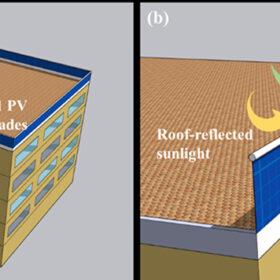
Vertical bifacial photovoltaic balustrade for building edges
Conceived by scientists in Hong Kong, the solar balustrade integrates bifacial PV panels and is considered an ideal solution for “cool roofs.” Roof albedo and module orientation are critical drivers of system performance.

Ultra-short-term PV forecasting based on convolutional neural network, long short-term memory
Scientists have created a novel probabilistic model for 5-minutes ahead PV power forecasting. The method combines a convolutional neural network with bidirectional long short-term memory, attention mechanism, and natural gradient boosting.

Open-source dataset for rooftop PV generation in urban environments
A group of scientists has developed an open-source dataset comprising three years’ worth of data from Hong Kong’s largest behind-the-meter rooftop solar power project. Power generation was collected at 5-minute intervals, and meteorological data at 1-minute.
