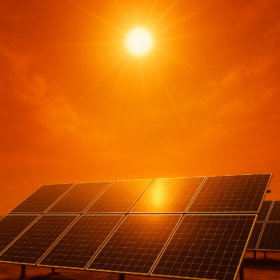
Dual PV module cooling tech based on water, air
Scientists in Hungary have built an experimental rig that uses a 60 W polycrystalline solar panel with 152 holes drilled into its frame for air cooling, as well as high-conductivity copper alloy pipes and fins placed on its back for water cooling.

Hungary’s solar capacity surpasses 8 GW
Hungary’s Ministry of Energy says rising levels of solar production contributed to keeping the share of imported electricity below 20% across the first six months of the year, compared to nearly 25% over the same time period last year.

Researchers identify optimal level of solar, battery storage for European energy market
Researchers in Hungary have developed a model to calculate the optimal PV and battery storage balance to support the European grid in the next few years. They found that the cost-optimal range is at 530–880 GW of PV, combined with battery storage equivalent to 2.5–7.5% of the total intermittent capacity.

Hungary’s largest battery storage facility comes online
MET Group has switched on Hungary’s largest battery, a 40 MW/80 MWh system, at the site of a power station near Budapest.

Hungary’s solar capacity nears 8 GW
Data from transmission system operator MAVIR shows that solar energy production in Hungary reached a new peak on June 13, producing enough energy to serve the country’s domestic electricity requirements entirely from renewables.
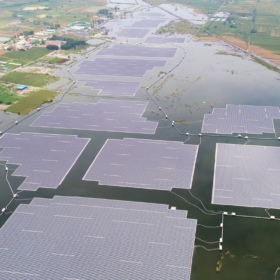
Water-based photovoltaics reach global capacity of 21.18 GW
An international research team has developed an index-based remote sensing method to see trends in the global development of water-based PV. It has found that China currently accounts for 80% of the global total deployed capacity.

Low residential solar feed-in tariffs can encourage battery deployment
Analysis of feed-in tariff scenarios in Central and Eastern Europe finds that while high feed-in tariffs are linked to the adoption of residential solar, lower tariffs are more likely to encourage battery installations. The study proposes a moderately low range of tariffs as one compromise to support both technologies.

Hungary adds 1.4 GW of solar in 2024
Utility-scale solar accounted for around half of new solar in Hungary last year, but with no new connection permits for large-scale projects over the last two years, this market segment is predicted to slow in the coming years.
Axpo offtakes 60 MW from Hungarian solar plants
Swiss power producer Axpo has signed its first power purchase agreement (PPA) in Hungary for three solar plants that began operations in 2024.
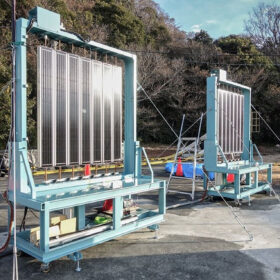
Novel BIPV concept integrates louvers to enhance power production
Scientists have proposed a building-integrated PV system that integrates airflow to cool the panels and control room temperature. The system, which also acts as a shading device, can reportedly mitigate drops in power generation efficiency without additional energy consumption.
