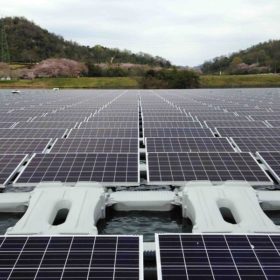
Indian state launches floating solar tender
Developers have until September 30 to lodge their interest to install grid-connected floating solar plants on the water reservoir surface at Salaulim, Amthanem, Anjunem, and Chapoli Dams in the Indian state of Goa. Their scope of work also includes assessing the floating solar potential at each of these locations.

Tata Power wins 330 MW of solar projects in central Indian state
TP Saurya Ltd., a unit of Tata Power, has secured a letter of award to build 330 MW of PV capacity in the 500 MW Neemuch Solar Park, in the Indian state of Madhya Pradesh.

Indian Railways could power one in four trains with its own solar panels
Feeding solar electricity directly from its own panels into overhead lines, on a fully-electrified rail network, would be more cost-effective for the state-owned company than buying that green power from the grid, according to a new study.

India’s Reliance Industries may acquire REC Solar
Mumbai-based Reliance Industries and REC Solar have declined to comment on rumors that the Indian company might acquire the Norwegian PV module maker, in a potential transaction that Indian media outlets have already valued at $1 billion to $1.2 billion.

Goldi Solar unveils M10 modules
Indian manufacturer Goldi Solar has introduced the HELOC̣ Pro series, featuring mono-facial and bifacial modules based on M10 wafers.
‘The chance to reset with a green recovery has now been lost’
Norwegian consultancy DNV today published the latest of its annual surveys of the state of the energy transition and lamented the fact so very little has been achieved during the last five years. We are forging ahead into a world that will be 2.3C hotter this century, predicts the report.
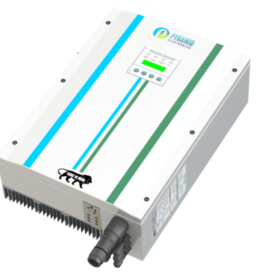
Indian manufacturer unveils new string inverters
Pyramid Electronics has released three-phase string solar inverters based on silicon carbide power devices. The inverters are available in power ratings ranging from 5 kW to 15 kW, including models with three maximum power point trackers.
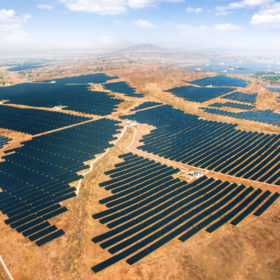
ArcelorMittal plans 4.5 GW solar park in India
The Luxembourg-based steelmaker is considering setting up a 4.5 GW solar park in the Indian state of Rajasthan. It also plans to invest in the solar, wind, and hydrogen gas production sectors in the state of Gujarat.
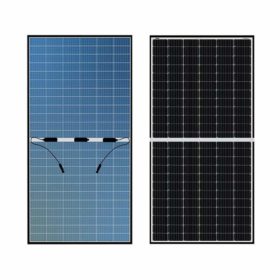
Loom Solar unveils 440W/530W bifacial modules
India’s Loom Solar has launched its Shark line of bifacial PV modules for rooftop projects. The nine-busbar panels have power outputs ranging from 440 W to 530 W, with front-side efficiencies ranging from 20% to 21% and rear-side gains of up to 20%.

India met 72% of H1 electricity demand with solar, wind
New figures from India paint a better picture for it than other Asian nations, where fossil fuel-based generation accounted for a much bigger share in meeting rising electricity demand in the first six months of this year.
