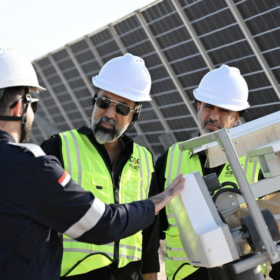
Iraq’s largest solar project enters trial operation
Iraq’s Ministry of Electricity says an initial 61 MW from the first unit of a planned 1 GW solar project has commenced. The project is being developed across four 250 MW units, with final commissioning currently scheduled for 2028.

Iraq slashes solar import tariffs to 5%
The Iraqi Customs Authority has cut customs duties on solar energy systems from 33% to 5% – covering PV panels, inverters, cables, and lithium batteries – to accelerate solar adoption, following financing support from the Central Bank of Iraq.

Reducing PV module temperature with leaf vein–inspired fins
Researchers in Iraq have developed biomimetic leaf vein–inspired fins for photovoltaic panels, with reticulate (RET) venation reducing panel temperature by 33.6 C and boosting efficiency by 18% using passive cooling. Their study combines 3D CFD simulations and electrical evaluations to optimize fin geometry, offering a sustainable alternative to conventional cooling methods.

All low-cost PV monitoring systems at a glance
A group of scientists in China conducted a comprehensive review of existing low-cost photovoltaic monitoring approaches. They found that only 11 out of 88 studies related to PV monitoring incorporate machine learning. The researchers urge the scientific community to place greater emphasis on lightweight machine learning solutions and smartphone-based integration.
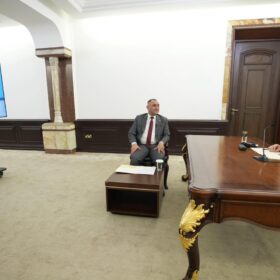
Iraq inaugurates first phase of largest solar plant to date
The first phase of the Karbala solar power plant, totaling 22 MW, is now online. Its capacity is expected to reach 75 MW within the next two moves, ahead of a final 300 MW target.

Scientists design lead-free 2T all-perovskite tandem solar cell with potential 28.22% efficiency
The proposed tandem features a wide bandgap antimony-doped Cs2AgBiBr6 (specifically Cs2AgBi0.75Sb0.25Br6) top cell and a narrow bandgap formamidinium tin iodide (FASnI3) bottom device.
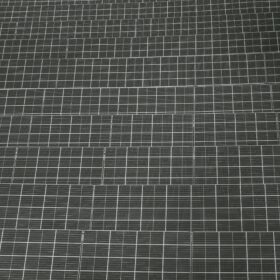
TotalEnergies starts building 1 GW solar plant in southern Iraq
France’s TotalEnergies has broken ground on a 1 GW solar project in Iraq. The first 250 MW phase is due to come online before the end of this year.
Dual PV module cooling tech based on water, air
Scientists in Hungary have built an experimental rig that uses a 60 W polycrystalline solar panel with 152 holes drilled into its frame for air cooling, as well as high-conductivity copper alloy pipes and fins placed on its back for water cooling.
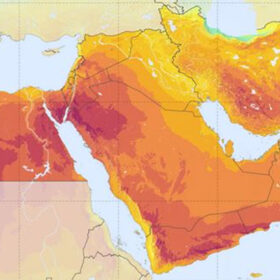
New method for PV site suitability mapping
Scientists in Malaysia have developed a novel deep-learning method for PV suitability mapping. Applying the new approach to the Middle East, they found that approximately 5.8% of the region has very high suitability and 11.5% is highly suitable for PV energy development.

UGT Renewables to build 3 GW of solar in Iraq
UGT Renewables, a US-based developer, says it will build a 3 GW solar project in Iraq under a deal with the federal government that includes 500 MWh of storage and 1,000 km of high-voltage direct current (HVDC) lines.
