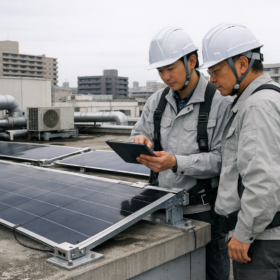
Japan publishes new guidelines for flexible solar cell installations
Japan’s New Energy and Industrial Technology Development Organization (NEDO) says its new design and construction guidelines for flexible PV and perovskite solar installations will help ensure the safety and reliability of systems deployed on low-load rooftops and wall surfaces where conventional panels cannot be installed.

Japanese researchers achieve world record efficiency of 12.28% for copper gallium selenide solar cell
Researchers in Japan have achieved a 12.28% efficiency in a copper gallium selenide solar cell, the highest reported for indium-free wide-bandgap chalcogenide absorbers in the 1.65–1.75 eV range. The device uses aluminum-engineered films with a back-surface field and optimized cadmium sulfide buffer layers to enhance voltage, reduce recombination, and improve overall performance.

Japan establishes national benchmarks for agrivoltaics as sites expand
The Japanese government has defined new standards for agrivoltaics as regulators begin tightening oversight in response to nearly one-quarter of projects reporting reduced crop yields or sub-standard cultivation beneath solar panels.

Toshiba rolls out AI-powered solar plant portfolio management platform
Toshiba has unveiled a PV management platform within its Spinex for Energy portfolio that enables real-time monitoring and O&M of multiple solar plants.
The system uses AI to track plant performance, detect faults, calculate capacity and PR metrics, automate reporting, and support troubleshooting.
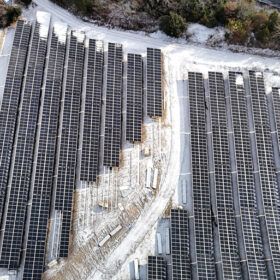
Japan’s 27th solar auction concludes with average final price of $0.029/kWh
Japan has allocated 79 MW of PV capacity in its latest procurement exercise. The lowest price in the auction was JPY 0/kWh.
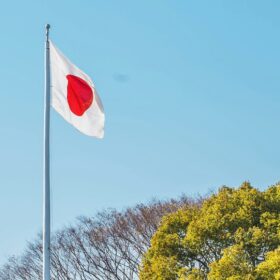
Japan adds 5.8 GW of solar in 2025
Estimates indicate Japan added between 5.8 GW and 6 GW of solar last year, likely taking the country past 100 GW of cumulative solar capacity. Last year’s installations were led by the commercial and industrial market, while the residential sector also saw increased demand.
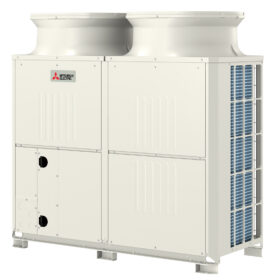
Mitsubishi Electric Trane announces new heat pump line for hydronic heating
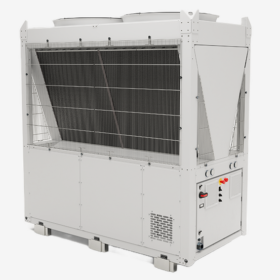
The systems deliver outlet water temperatures up to 74 C, operate in ambient temperatures from -25 C to 43 C, and can be cascaded in groups of up to 16 units for larger commercial applications.
Daikin launches new propane heat pumps for commercial, industrial applications
Daikin has introduced two new propane heat pump lines for industrial and district heating applications, combining monobloc units from 20 kW to 85 kW with modular systems scalable up to 2 MW.
Osaki Electric signs EMS development pact with Kyocera, Taiwan Plastics
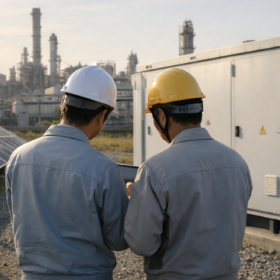
Osaki Electric says it has signed an agreement to formalize joint development of its AI-based energy management system (EMS), integrating solar generation and lithium iron phosphate (LFP) battery storage. It aims to sign a final contract by December 2026.
Japanese scientists build near-white heterojunction solar cell for BIPV applications
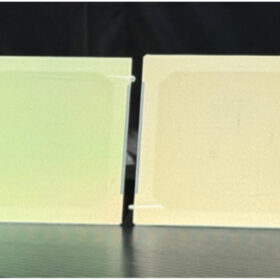
The lab-scale, near-white heterojunction solar cell uses nanoclay-based scattering layers combined with dielectric multilayer films to preserve power conversion efficiency while enhancing visual appeal. The researchers report optical losses of less than 1% at a 50% clay volume fraction, which are significantly lower than those observed with textured glass.
