
Malaysian utility launches rebate program for residential PV
Sarawak Energy says it will grant rebates of up to $2,800 for PV systems planned to operate under Malaysia’s net metering scheme.

Brookfield, Solarvest partner on 1.5 GW of solar-plus-storage in Malaysia
The two parties have signed a joint investment framework agreement to develop, construct and operate 1.5 GW worth of solar-plus-storage projects in Malaysia over the next three to five years.

Malaysian utility plans solar expansion
Sarawak Energy Berhard is working on both expanding its solar capacity and conducting feasibility studies for pumped storage hydropower projects at three locations in the Malaysian state of Sarawak.

Powering ferries with floating PV, hydrogen
Scientists in Malaysia have conducted a techno-economic-environmental study of a green fueling system for a ferry that runs between islands in their home country. Using 40,000 solar panels, they were able to power two round trips round-trips per day. Annual CO₂ reduction was measured at 23.75 million kg.

Malaysia approves 2 GW of large-scale solar
The fifth round of Malaysia’s large-scale solar programme has approved 13 projects with a total capacity of 1,975 MW. Among them is a 200 MW floating solar project, one the country’s largest to date.

New deep learning tech for PV inverter fault diagnosis
A team of scientists in the United States has combined both spatial and temporal attention mechanisms to develop a new approach for PV inverter fault detection. Training the new method on a dataset created in MATLAB/Simulink, the group has compared it to a series of other data-driven and statistical-based methods and has found accuracy reached 97.35%.

Malaysian partners to develop 1.5 GW of solar
Subsidiaries of Gentari and Gamuda will develop 1.5 GW of solar with battery storage in Malaysia to supply hyperscale data centers under the Corporate Renewable Energy Supply Scheme (CRESS), supporting the country’s push to expand clean energy and meet rising tech-sector demand.
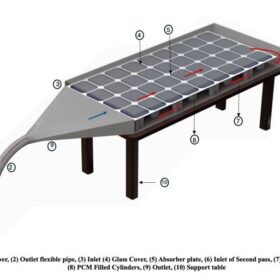
Photovoltaic-thermal solar air heater based on PCM cylinders, air convection
Researchers in Malaysia designed a photovoltaic-thermal system that can be used in solar drying, space heating, rooftop systems, and off-grid thermal applications. It relies on a double-pass cooling technique based on air convection and phase change material that can reportedly increase PV efficiency from 7% to 9% and thermal efficiency by 31.45%.

Tokuyama, OCI begins construction on polysilicon factory in Malaysia
The new manufacturing facility will be located at the Samalaju Industrial Park in Sarawak, Borneo, and will have a capacity of 10,000 MT.

Malaysian utility unveils hydro-floating solar, hydrogen hubs
Tenaga Nasional Berhad says the newly-announced hybrid hydro floating solar hub and green hydrogen hub will position Malaysia as a regional leader in the green hydrogen value chain.
