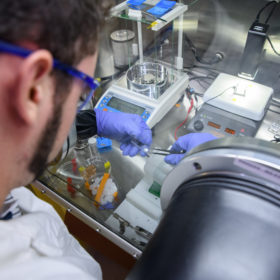
Battery scientists make a cracking observation
Scientists at the Georgia Institute of Technology in the U.S. used x-ray imaging to observe cracks forming in a solid state lithium battery, a discovery they say changes the understanding of performance of solid state batteries and which could lead to more durable systems.

The second Democratic debate: The return of the Green New Deal
The first debate, featuring the two front-runners for the Democratic nomination, showed clear and growing divisions within the Democratic Party on climate policy as much as everything else.
Product recall: SMA calls in MLPE over rapid shutdown problem
The inverter maker conducted tests and found the branded SMA TS4-R-F-42 could not always supply the rapid shutdown function called for by a new U.S. safety standard when applied in commercial and industrial systems featuring its inverter tech.

Amtech nears final solar exit with SoLayTec sale
The Arizona-based equipment maker is sticking to its guns by withdrawing from the PV market after sales wobbled in China last year. With most of the big players having rediscovered their thirst for expansion, however, it appears a curious strategy.
Los Angeles seeks record sub-two cent solar power price
The city’s municipal utility is readying a 25-year power purchase agreement for 400 MWac of solar at $0.01997/kWh along with up to 200 MW/800 MWh of energy storage at $0.013/kWh.
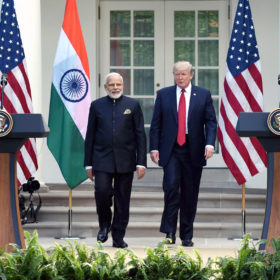
India wins WTO solar dispute against US
A World Trade Organization panel has found a U.S. move to incentivize the use of domestic solar products put imported goods from India and other countries at a disadvantage.
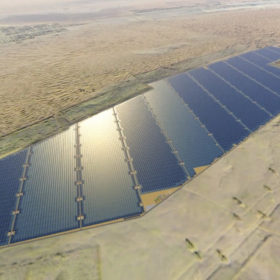
Jinko makes a convincing case as it upgrades mono capability
The Shanghai-based wafer, cell and module maker appears to be steering a steady course through a tumultuous period for the solar industry and its plans are another sign high-efficiency modules may soon have to do more to earn that label.
Talesun pivots Thailand fab towards sanctioned US market with high efficiency retrofit
The Chinese manufacturer has embarked upon an upgrade of 1.5 GW of its module production lines which is set to be completed this year. Previously used to get around trade restrictions applied by the EU, the Thai facility will now produce output for the U.S. market.

Researching some cool new battery materials
Scientists from China and the United States have developed an additive for electrolyte materials they say could improve the operating temperature range for lithium-ion batteries, allowing them to operate down to minus 40 degrees Celsius without compromising performance at temperatures up to 60 degrees Celsius.

Akasol plans to build new battery factory near Detroit
The German battery manufacturer will make products for electric trucks and buses at the facility, which is expected to employ 200 workers and produce 400 megawatt-hours of batteries annually.
