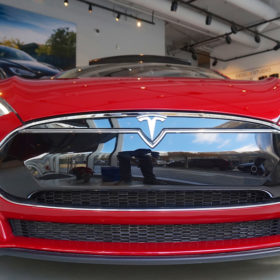
Tesla’s solar business shrinks as Musk focuses on Model 3
The EV, energy storage and solar company deployed only 47 MW of solar during Q1, as Tesla moves away from traditional sales methods towards web-based sales for its products.

Scientists make an exciton organic PV discovery
Researchers at the U.S. Department of Energy’s Lawrence Berkeley Laboratory have found a mechanism for creating a charge in molecular materials. The findings, say the team, could lead to new approaches in the design of PV devices.

Canada’s Saskatchewan province tenders second large scale PV project
Utility SaskPower has closed the request for qualification phase for a 10 MW plant which prompted 22 applications from 13 companies. The province wants 60 MW of renewables by 2021. The tender for a first PV plant of the same size was finalized by SaskPower in June.

Facebook brings solar to two more US states
Dominion is building three solar projects and acquiring two more completed plants the U.S. states of Virginia and North Carolina. Add in one recently completed project, and the utility will be supplying 350 MWac to feed Facebook’s desire for emissions-free electricity.
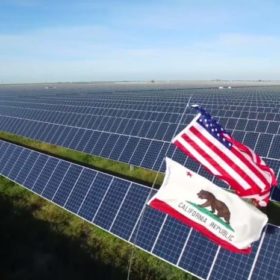
California just made more clean energy than it needed
The state grid operator has shown that for most of the period between 1:50 PM and 3:05 PM on Sunday, more carbon emission-free electricity than users demanded was generated in its region.

US presidential hopeful calls for huge increase in renewables on public lands
Senator and 2020 candidate Elizabeth Warren has announced plans for a targeted expansion of renewable energy development on public lands along with a moratorium on new fossil fuel leases.

Australia and India helped make up for Chinese solar retreat last year
The world had more than half a terawatt of PV generation capacity at the end of last year as emerging solar markets picked up the slack caused by Beijing’s subsidy about-turn to the tune of a 20% rise in installations outside China.
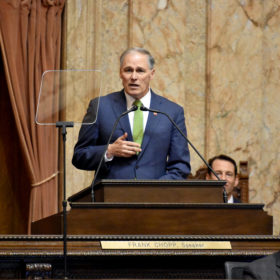
Washington state’s 100% renewables bill passes both Houses
Washington is looking to become the fourth state to make the move to 100% renewable electricity, with only a senate review and the hand of Governor Inslee left in the path of SB 5116.
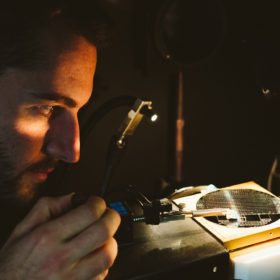
DuPont unit and Fraunhofer ISE to work on c-Si module testing
The PV solutions division of DuPont Electronics and Imaging has revealed plans to work with the Fraunhofer ISE on optimizing testing protocols for crystalline silicon solar modules.
California’s solar power record setting season is here
The state grid operator reported breaking 11 GW of instantaneous power from large scale solar on Saturday at 1.50pm. Just 20 minutes earlier, the CAISO grid was exporting a record 1.5 GW of electricity, and last Wednesday it hit 93% clean electricity for a moment.
