
Singapore installs 504 MW of solar in 2025
Figures from Singapore’s Energy Market Authority indicate that the country had a record year for solar deployment in 2025. Cumulative capacity surpassed 2 GW, leading to Singapore’s 2030 solar target being increased to 3 GW.

Maxeon files for restructuring in Singapore
Company statements in a filing with the U.S. Securities and Exchange Commission indicate it will seek an arrangement between itself and creditors that may allow it to survive “as a going concern.”
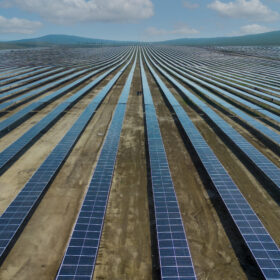
TotalEnergies, Masdar to merge renewables activities in nine Asian countries
The two major developers plan to establish a joint venture company with equal ownership that will be their sole vehicle for building, owning and operating both existing and future solar, storage and wind projects across nine Asian countries.

Pushing perovskite solar cells to the ultimate thickness limit
Researchers in Singapore have developed fully vacuum-processed ultrathin perovskite solar cells with absorber layers as thin as 10 nm, achieving high transparency and stable efficiencies up to 12%. These cells balance optical transparency and electrical performance, offering scalable, design-flexible photovoltaics suitable for seamless integration into buildings.
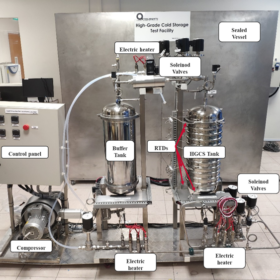
Cold thermal storage crucial to boosting liquid-air energy storage efficiency
Researchers reviewed 110 studies on cold thermal energy storage in liquid-air energy storage, finding that cold storage performance has a far greater impact on system efficiency than previously assumed. While phase change materials offer high theoretical efficiency gains, simpler packed-bed sensible heat systems are currently the most mature and cost-effective option, with further experimental validation needed to bridge the gap to large-scale deployment.

Singapore raises 2030 solar target to 3 GW
Singapore has increased its 2030 solar target by 1 GW after surpassing the original 2 GW goal before the end of last year.
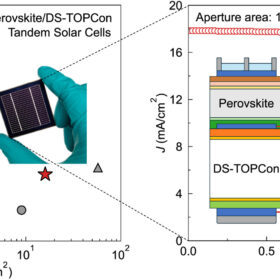
SERIS builds 22.1%-efficient perovskite-silicon tandem solar cell based on double-sided polysilicon layers
SERIS researchers developed a 16-cm² perovskite-silicon tandem solar cell with a double-sided TOPCon bottom cell, enhancing passivation, reducing recombination, and increasing voltage and fill factor.
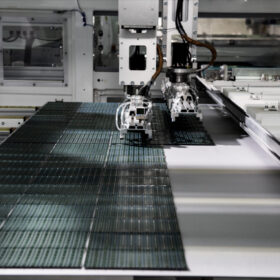
Aiko, Maxeon settle global back-contact patent dispute
Under the terms of the agreement, Aiko will be licensed to Maxeon’s back-contact solar cell and module patents outside the U.S., while both companies drop all ongoing legal actions.

Singapore forecast to reach 5.3 GW of solar by 2035
UK consultants GlobalData say Singapore could add between 300 MW and 400 MW of solar annually through to 2035, taking cumulative capacity from around 1.9 GW today to the 5 GW threshold.
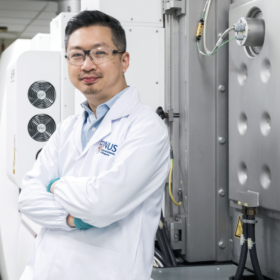
Singapore team develops durable perovskite-silicon tandem solar cells
National University of Singapore scientists claim that vapor-deposited perovskite-silicon tandem solar cells built on industrial silicon wafers achieve both high efficiency and long-term thermal stability, addressing a central barrier to commercial deployment.
