
Swiss startup offers lifetime guarantee for second-life batteries
Switzerland startup Evolium Technologies’ subscription-based business model offers residential battery owners a lifetime guarantee on second life batteries. The startup tests and remotely monitors each battery cell so it can alert customers when a cell is under-performing.
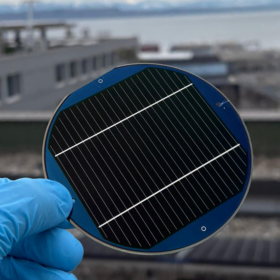
EPFL, CSEM achieve world record efficiency of 30.02% in perovskite-silicon triple-junction solar cell
An international research team boosted triple-junction solar cell performance by enhancing perovskite crystal growth, increasing middle-cell light absorption, and adding reflective nanoparticles.
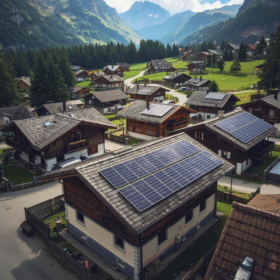
Is Switzerland going back contact?
In 2025, back-contact solar modules from Aiko Solar and Longi accounted for more than 50% of the Swiss market, driven by strong demand for high-efficiency rooftop PV systems, according to a new report by Eturnity and the Bern University of Applied Sciences.
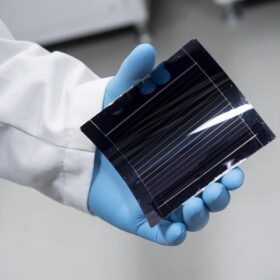
Why CIGS solar keeps lagging behind crystalline silicon
In an interview with pv magazine, Empa scientist Mirjana Dimitrievska explains that the CIGS photovoltaic technology, while promising for efficiency and flexible applications, faces persistent challenges in scaling lab-level performance to cost-effective, high-throughput industrial production, limiting its ability to compete with crystalline silicon. She also emphasizes that long-term stability, reliability, and material sustainability, rather than peak efficiency, are crucial for commercial viability, especially in niche markets like building-integrated and lightweight PV.
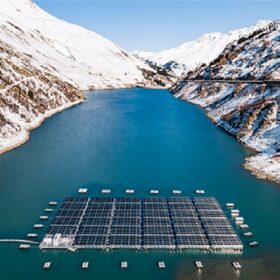
Switzerland streamlines construction of large-scale solar plants
Switzerland will implement amendments to its Energy Act on April 1 to shorten planning and permitting for solar, wind and hydropower projects of national interest, while also simplifying grid expansion and appeal procedures.
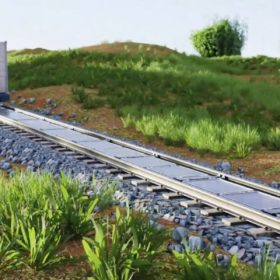
French railway operator tests solar on train tracks
Swiss startup Sun-Ways is testing removable solar panels installed on an operational railway line through a pilot project with French railway operator SNCF in Switzerland.
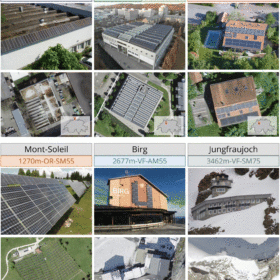
Study finds much lower-than-expected degradation in 1980s and 1990s solar modules
Researchers at SUPSI found that six Swiss PV systems installed in the late 1980s and early 1990s show exceptionally low degradation rates of just 0.16% to 0.24% per year after more than 30 years of operation. The study shows that thermal stress, ventilation, and material design play a greater role in long-term module reliability than altitude or irradiance alone.
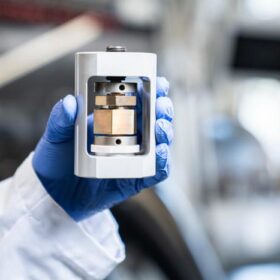
Swiss researchers improve electrolyte design for long-life solid-state batteries
A Swiss research team has developed a low-temperature sintering and interface-coating process that significantly improves the durability of argyrodite-based solid-state batteries. The approach delivers high ionic conductivity and long cycle life, retaining 75% of capacity after 1,500 cycles.
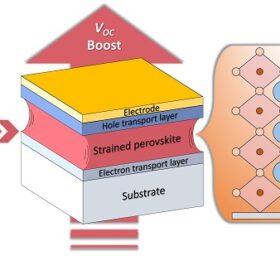
EPFL researchers enhance perovskite solar cell performance via rubidium
Researchers led by Michael Grätzel at the Ecole Polytechnique Federale de Lausanne in Switzerland have recently led efforts to improve perovskite optoelectronic properties using small-radius rubidium ion chemistry to enable more stable and efficient perovskite solar cells.

Switzerland introduces winter electricity bonus for solar installations
Switzerland is implementing a new winter electricity bonus for solar installations larger than 100 kW that generate over 500 kWh/kW of electricity in the winter half-year from October 1 to March 31. The country’s Federal Council has also raised the target for electricity generated by photovoltaics to 18.7 TWh by 2030.
