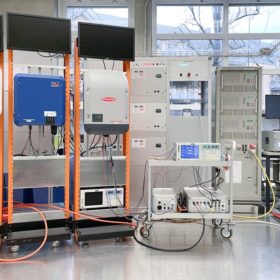
Survey shows 34.3% failure rate for residential inverters over 15 years
The Bern University of Applied Sciences in Switzerland has published the initial results of a survey on the durability and performance of residential PV inverters and power optimizers over a 15-year period. They found that more than 65% of the inverters did not present yield-relevant faults by their 15th year of operation.
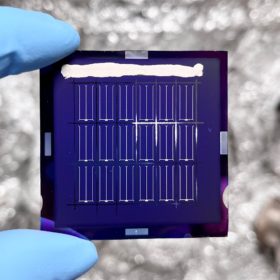
Silver-alloyed CGIS solar cell with 18.7% efficiency
Swiss scientists have used a minimal amount of silver to alloy the absorber in a thin-film CIGS solar cell. They say this process could help to improve efficiency, open-circuit voltage, and fill factor, while compensating for the low bandgap of the CIGS layer.
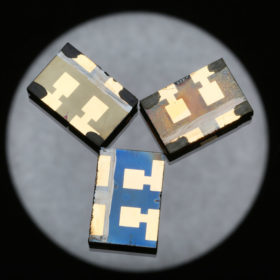
A look into a crystal ball reveals the secrets of perovskite solar cell stability
Scientists in Switzerland and South Korea looked deep into the crystalline structure of a perovskite thin-film to better understand the mechanisms behind the sensitivity to heat and moisture that causes so many stability issues for solar cells based on these materials. They discovered a part of the crystal’s surface that is particularly vulnerable to moisture-induced degradation, and developed an approach to grow perovskite thin-films with strong resistance to moisture and thermal stress.
Consumers have a right to know the energy make-up of goods
With energy certification already a must-have for any business which makes green energy claims, Ed Everson, chief executive of England-based, global certification company Evident, makes the case for firms to be required to make full disclosure of their energy sources.

Switzerland introduces rebate scheme for solar
Switzerland has announced a new one-off incentive model for solar, in order to reimburse up to 60% of investment costs for installations that meet certain criteria. The scheme exists in addition to nonrecurring remunerations for small and large PV installations.
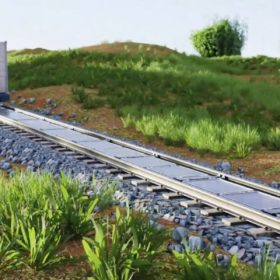
Swiss startup makes first attempt to deploy solar on railways
Swiss startup Sun-Ways has developed a patented solution under which it directly rolls out solar modules between railway tracks like a carpet. The panels can be removed at any time for maintenance work.
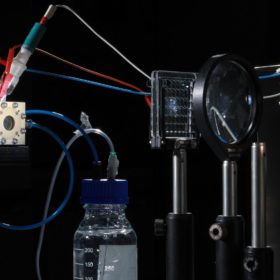
Solar-powered artificial leaf to produce hydrogen from air
Chemical engineers in Switzerland have invented a solar-powered artificial leaf. Their solar-powered, transparent and porous electrode turns water from its gaseous state in the air into hydrogen fuel.
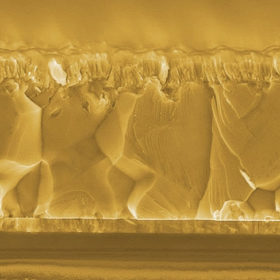
New process increases efficiency of CIGS bifacial thin-film solar cells
Researchers from the Swiss Federal Laboratories for Materials Science and Technology (Empa) have developed a new low-temperature production process for bifacial thin-film solar cells based on copper indium gallium diselenide (CIGS). It resulted in record yields of 19.8% for front lighting and 10.9% for rear lighting.
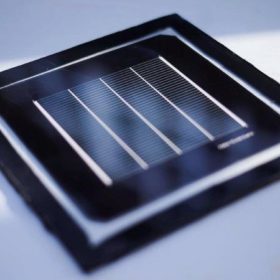
Meyer Burger to commercialize 29.6%-efficient perovskite tandem solar cells
Meyer Burger is working with several research institutes in Switzerland and Germany to integrate perovskite tandem technology into its manufacturing processes.
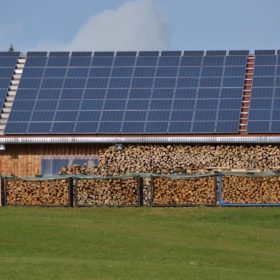
Switzerland introduces auction scheme for solar over 150 kW
The Swiss authorities plan to hold auctions for PV systems to be deployed on hangars and barns. The new scheme is part of a package of new incentives for PV in the country.
