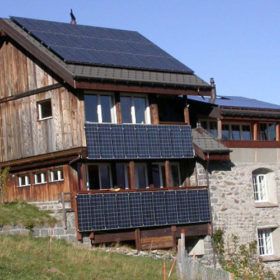
Switzerland: New PV additions for 2017 range between 250 and 270 MW
According to provisional figures released by Swissolar, solar demand remained stable in the country last year. Looking ahead, the association expects another 300 MW to be deployed this year.
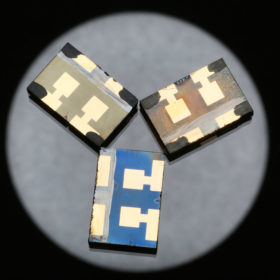
EPFL proposes standard measurements for perovskite aging
Scientists working on perovskite solar cells at Switzerland’s École Polytechnique Fédérale de Lausanne have proposed a method of standardization for the measurement of stability and degradation in perovskite solar cells, in order to create consensus and speed up commercialization of the technology.
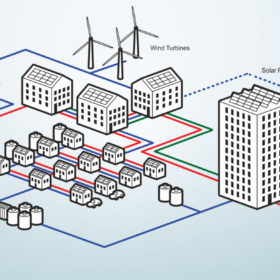
ETH Zürich demonstrates decentralized energy systems
Researchers at ETH Zürich have published a paper illustrating the potential for distributed energy systems with solar at their heart, as a replacement for the current centralized energy system.
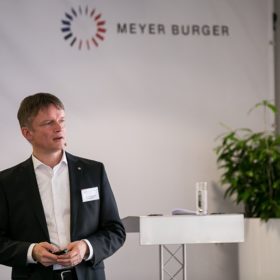
Simple, powerful, demonstrable: Meyer Burger on why HJT is poised for the mainstream
Interview: Following the announcement earlier this month that Swiss production equipment supplier Meyer Burger has increased the power output of its HJT SmartWire module to 335W, pv magazine caught up with company CTO, Gunter Erfurt to understand more about the process, as well as the company’s longer-term tech roadmap.
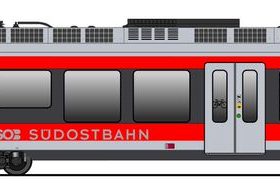
Idea of solar powered trains gaining traction
In two separate studies, in the U.K. and Switzerland, respectively, the notion of combining solar power and trains has been explored. The results indicate it could offer a cost-competitive, energy saving alternative to the traditional power methods currently employed.
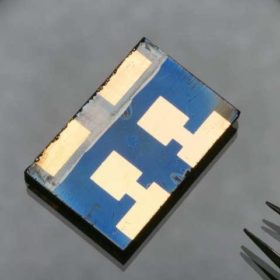
EPFL-led research group seeks to stabilize perovskite solar cells with guanidinium
The group of scientists is adopting organic cations, instead of inorganic cations like cesium or rubidium, to stabilize the crystal structures of perovskites with solar applications.
Meyer Burger announces at least 100 jobs will go at Thun
Following a consultation process with employees, Meyer Burger has announced 100 jobs will definitely go as part of the closure of its Swiss manufacturing site. Another 60 positions are dependent on strategic alternatives being found.
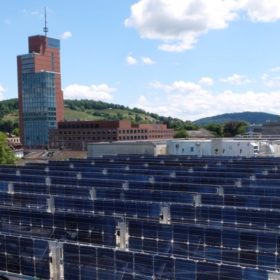
Switzerland to replace FITs with solar rebates in 2018
According to Swissolar, this change will allow more PV capacity to be deployed, as waiting times for the implementation of FIT contracts are considerably increasing. Self-consumption is also becoming more attractive for multi-family houses and commercial enterprises.
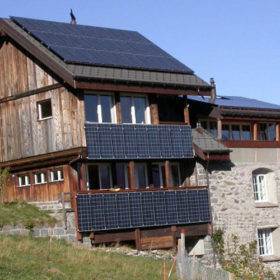
Switzerland’s solar power production could reach 19 TWh by 2050
A report from the Paul Scherrer Institute forecasts a bright future for PV technology in the Alpine country. Solar may even be able to grow by 18 TWh over the next 30 years from just 1 TWh currently.
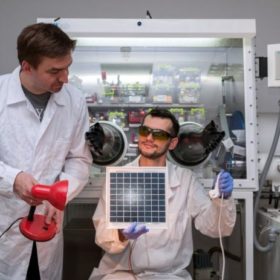
Scientists grind out solvent free perovskite thin-film process
Researchers from the Institute of Physics of the Polish Academy of Sciences (PAS) and the renowned Ecole Polytechnique Federale de Lausanne (EPFL) have collaborated on a new technique for the creation of perovskite solar cell materials. The technique replaces traditional solvent based processes with steel ball mill grinding.
