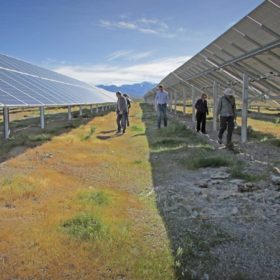
Desert solar farms can improve tortoise habitat
With openings in the fence and improved growth of plants vital for tortoise survival, solar farms in Nevada can provide better habitat than the surrounding desert. First Solar has found similar habitat gains in California.

More accusations of discrimination at Momentum Solar
A former employee is suing the U.S. company over allegations that she was terminated once she informed management about her high-risk pregnancy.
Solar industry snagged $27.8 billion in finance for company building, projects in 2019
Mercom Capital has released their annual report for 2019, describing the year as robust and showing company funding of $11.7 billion, up 20% over 2018, on top of announced project deals of $16.1 billion, up 14%.

Why Europe and the US failed to capitalize on thin film solar
Is First Solar stalled in innovation and growth? Markus Beck, a thin-film solar expert and former chief technologist at First Solar, provides an industry perspective on the fate of thin-film PV in the United States.

Putting the strain into engineering a more stable perovskite
U.S. researchers claim to have improved the stability of one of the most promising halide perovskites – α-FAPbI3 – by squeezing the compound’s crystal lattices. The authors of the research prevented the crystal assuming an hexagonal shape at the room temperatures required for a PV device to operate properly.

Solar cells from space are on the way
A team at the U.S. National Renewable Energy Laboratory has come up with a new process that would reduce the production cost of highly expensive – and highly efficient – gallium arsenide cells.

First Solar reaches $350m legal settlement with shareholders to halt 2012 lawsuit
The U.S. thin-film manufacturer continues to deny having misled stockholders over solar module defects between 2008 and 2012 and said the settlement had been reached to close the historic legal action and permit the company to remove the uncertainty associated with it.

A new perovskite material for solar applications
Barium zirconium sulfide is another chalcogenide perovskite being tested in relation to the development of more efficient solar cells. Researchers at Buffalo University, in New York state, have created a thin-film based on the material they say offers significant light absorption and good charge transport.

The world will add 142 GW of new solar this year
IHS Markit has predicted another year of global solar growth but a peek behind the headline figures shows uncertainty dogging the markets of China and India, two of the most important markets and biggest polluters.
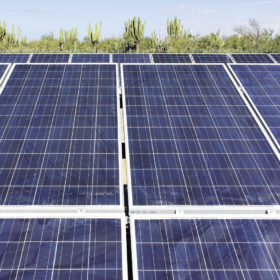
Repowering solar plants for need – or bigger returns
Alencon’s silicon carbide-based String Power Optimizers and Transmitters enable the repowering of solar plants which need to replace 600 V inverters with newer 1,000 V or 1,500 V gear, or for project owners who wish to maximize electricity generation at aging and imperfect facilities with creative engineering techniques.
