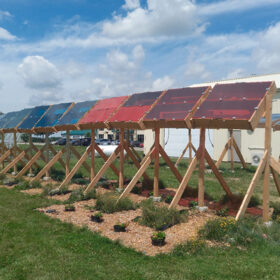
Agrivoltaics for turnips
Researchers in Canada found that semi-transparent cadmium telluride and low-transparency crystalline silicon solar panels can boost turnip root and leaf yields in agrivoltaic systems by optimizing light quality, distribution, and heat stress. Their study highlights that PV module type, transparency, and spectral transmission must be carefully matched to plant physiology to maximize both crop productivity and renewable energy generation.
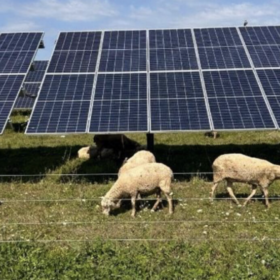
Solar sheep grazing delivers margins up to 40% in new study
Researchers at Western University say agrivoltaic sheep grazing models in Ontario outperform traditional farming, with higher margins and dual revenue streams from livestock and solar site services.
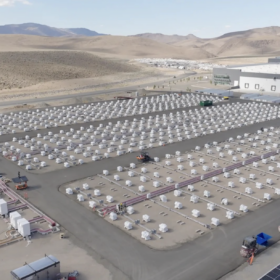
Second-life EV batteries approved for data center microgrid expansion
Crusoe and Redwood Energy are scaling a microgrid in Sparks, Nevada, by using repurposed electric vehicle batteries and solar to supply additional modular data centers.
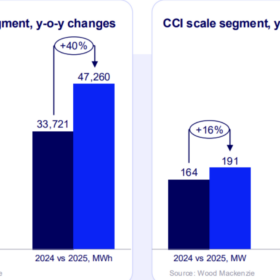
US installs record 18.9 GW of energy storage in 2025
The United States added 18.9 GW of energy storage capacity in 2025, a 52% increase year on year, according to Wood Mackenzie.
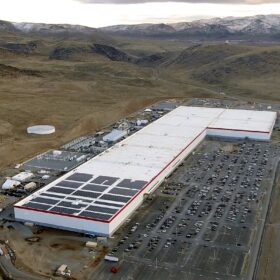
Tesla advances plan to build 100 GW of U.S. PV manufacturing capacity by 2028
Job advertisements on Tesla’s website outline the 100 GW ambition and follow reports the company is in talks with Chinese firms for the purchase of $2.9 billion worth of equipment for solar manufacturing.

Solar cyber threats expand, but inverters still stay in the crosshairs
In an interview with pv magazine, Jay Johnson, the CTO of US-based cybersecurity firm DERSec, explains that PV systems face cybersecurity risks that extend far beyond inverters, as demonstrated by a December attack on Polish solar plants where wiper malware targeted substation equipment rather than the inverters themselves. Vulnerabilities often lie in backhaul communication channels like APIs and mobile apps, making layered defenses, network segmentation, and vigilant monitoring essential to safeguard distributed energy resources.
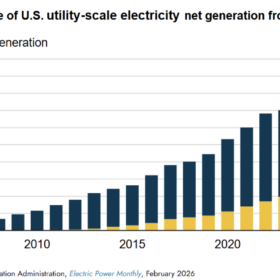
Solar and wind reach record 17% of US power generation
Combined generation from wind and utility-scale solar reached a record 17% of the US electricity mix in 2025, producing 760,000 GWh, up 88,000 GWh from 2024, according to the US Energy Information Administration (EIA).
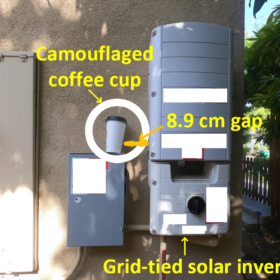
When tiny magnets attack PV systems
In an interview with pv magazine, cybersecurity expert Mohammad Al Faruque explains how seemingly simple sensors in PV systems and other energy systems are surprisingly vulnerable to magnetic, electrical, and acoustic perturbations, which can remotely influence control systems without physical access. Protecting these sensors requires both strict physical security and the development of hardened, interference-resistant technology to safeguard critical infrastructure.
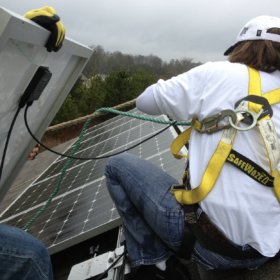
SiteCapture launches AI tool to automate solar field documentation
California-based software provider SiteCapture has launched an AI platform for the US solar market that automates job-site documentation, quality control, and reporting workflows for installers.

Sandia Labs benchmarks PV software providers in first ever blind comparison analysis
Sandia National Laboratories conducted the first-ever blind comparison of seven commercial PV modeling software, revealing that differences in weather handling, system modeling, derates, and assumptions grow as system complexity increases. The study emphasizes that software choice should consider project complexity, workflow, and modeling features rather than relying on rankings alone.
