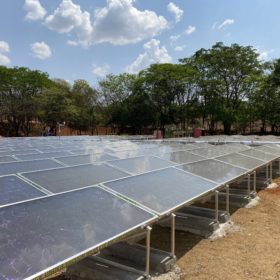
Solar thermal panel for large scale applications
The panel has an absorption area of 1.96 m2 and a weight of 27 kg per square meter. According to the manufacturer – Swiss startup TVP Solar – it may be a real booster for thermal output, by combining it with photovoltaics and heat pumps to provide enhanced output per square meter, in particular for low-temperature applications such as district heating.
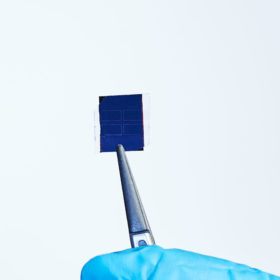
Monolithic perovskite-silicon solar cell with 20% efficiency via new lamination approach
The solar cell achieved an open-circuit voltage of 1.75 V, a short-circuit current density of 15.5 mA cm−2, and a fill factor of 73.6%. It was also able to retain 93% of its initial efficiency after 100 hours at a temperature of 80 C.
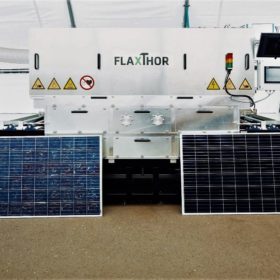
Industrial process for ‘mobile’ solar module recycling
German company Flaxres has developed an industrial process to recycle PV modules, and has begun operating a pilot facility at its new site where 10 tons of solar modules can be recycled daily. Flaxres plans to make equipment based on this facility available to international customers.
The Hydrogen Stream: Gas prices are higher than levelized cost of hydrogen for several technologies in Europe
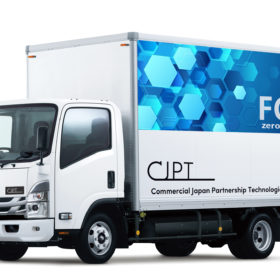
In other news, Toyota unveiled plans to roll out light-duty hydrogen fuel-cell trucks for the Japanese market next year and the UK has launched a contract for difference scheme for large scale hydrogen projects. Furthermore, Japanese scientists have designed a ruthenium complex with a nitrogen-containing organic compound to improve high-temperature proton conduction in fuel cells.

Project to build 1.4 GW high-voltage cable linking Germany with the UK moves forward
The European Investment Bank has agreed to provide €400 million ($406.5 million) in funds for the €2.8 billion project. Construction on the infrastructure should begin by the end of this year.
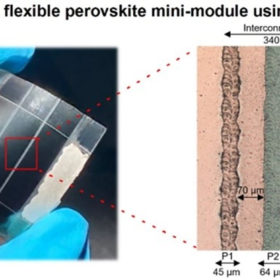
Four-terminal flexible perovskite-CIGS tandem mini-module with 18.4% efficiency
Swiss scientists have built a 4T tandem perovskite/CIGS mini-panel with a geometric fill factor of over 93%. It combines a 10.8%-efficient mini perovskite module and a 15.1%-efficient CIGS device.
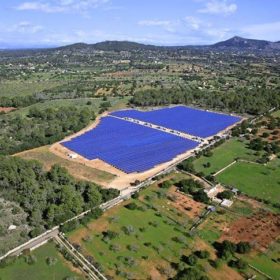
Spain launches 140 MW auction for distributed solar power
The auction will be held on October 25 and will be open to solar projects not exceeding 5 MW in size.

PEM fuel cell with novel biomimetic design
Spanish scientists developed a proton exchange membrane fuel cell with a bipolar plate based on a nature-inspired structure. This architecture, according to its creators, shows remarkable performance when operating at high relative humidity values of 90%.
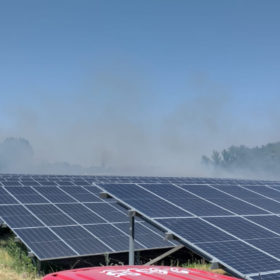
Heat wave sparks fire at solar park in the Netherlands
The fire affected an area of around 5,000 square meters but did not damage the solar panels. The local fire brigade was able to control the fire in around two hours.
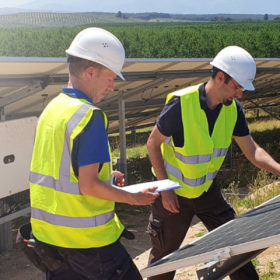
Considerations for solar projects during heat waves
High temperatures can affect different components of PV systems. Inverters can fail, the efficiency of solar modules can decline, and existing cell damage can become worse. However, investors, planners, and operators can adjust to heat waves in a number of different ways.
