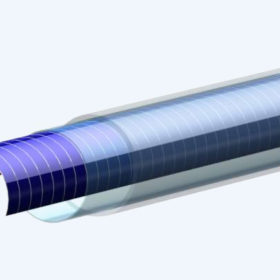
ZSW, Tubesolar achieve 14% efficiency for thin-film agrivoltaic solar tubes
TubeSolar and the Centre for Solar Energy and Hydrogen Research Baden-Württemberg have achieved a power conversion efficiency of 14% for a photovoltaic film based on perovskite.

World’s third-largest PV system on a stadium roof reaches completion
The stadium of German football club SC Freiburg hosts a 2.4 MW rooftop solar array relying on heterojunction modules provided by Swiss manufacturer Meyer Burger.
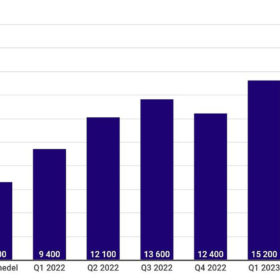
Rising number of grid-connected PV systems shows 2022 could be another record year for Swedish solar
Data from the Swedish association Svensk Solenergi shows some 21,500 PV systems were installed in the first half of the year, with a 90% growth compared to the same period a year earlier. The trade body also expects a substantial upswing in the spring of 2023.
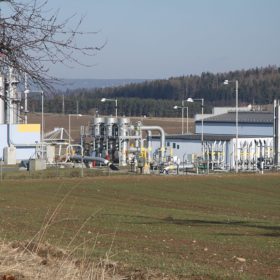
Oil and gas reservoirs are cheapest options for underground hydrogen storage
New research from Ireland shows that depleted oil and gas reservoirs may be used to store hydrogen at a cost of $1.29/kg. According to the researchers, underground hydrogen storage may benefit from the technological maturity of the geologic storage of natural gas and CO2, which are associated with decades of established knowledge.
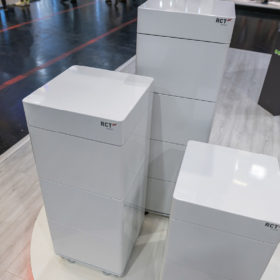
The weekend read: Energy storage efficiency and prices determine economics
Estimating the total cost of energy storage connected to a rooftop PV installation is a complex affair, involving factors such as tax, the policy environment, system lifetimes, and even the weather. As part of its extensive overview of distributed energy storage in Germany, pv magazine Germany analyzed the efficiency of different battery energy storage systems to create a comparable index that illustrates the cost of a stored kilowatt-hour.

Applying perovskite solar cells onto BIPV steel products
Swansea University will collaborate with Indian multinational Tata Steel to investigate perovskite solar cell materials that could be applied directly onto coated steel to make building-integrated PV components. The partnership will add to an “active buildings” project that the Welsh university has been running for several years.
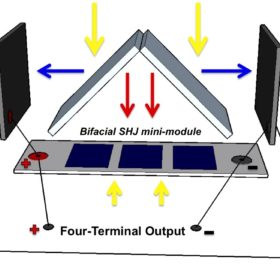
Four-terminal multijunction approach for bifacial modules
Scientists tested bifacial PV devices based on silicon and gallium arsenide cells connected in a four terminal layout. They note that the four terminal design offers significant advantages over more common two terminal devices, allowing for a 17% (relative) increase in efficiency thanks to better absorption of light reaching the rear side.
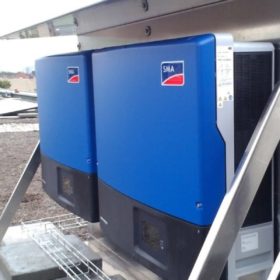
Study confirms rule of thumb that PV inverters should run without faults for around 15 years
A new study by Bern University of Applied Sciences shows that the performance of most PV inverters and power optimizers remains optimal for up to 15 years. The inverters considered came mainly from the manufacturers Fronius, Sputnik, and SMA and most of the power optimizers examined came from Solaredge.
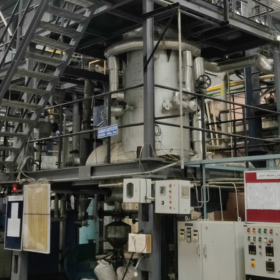
The Hydrogen Stream: Steam-based tech to produce 100 g of hydrogen from 1 kg of biomass
Researchers from the Indian Institute of Science (IISc) developed a two-phase hydrogen production technology that is capable of using steam to produce hydrogen from biomass. Furthermore, an Indian-Norwegian consortium is developing green ammonia in Oman, Toshiba is starting research on hydrogen production from geothermal energy, and Thyssengas is selecting personnel for the conversion of around 20% of its gas network.

Switzerland deployed 683 MW of solar last year
This year the Alpine country should see the deployment of up to 900 MW of new PV capacity. At the end of December, cumulative solar installations reached 3.65 GW.
