
Inverted perovskite solar cell with 24.1% efficiency
An international research group has developed an inverted perovskite solar cell with an active area of 9.6 mm2 by using polymer dipoles for interfacial engineering. It retained 96% of its initial power conversion efficiency after continuous maximum power point (MPP) tracking for 1,000 hours.

Only5mins! – Monetizing energy storage
Storage Hub founder Oliver Schmidt speaks with pv magazine about his outlook for battery energy storage pricing and the cost trajectory of electrolyzers. Schmidt’s new book, “Monetizing Energy Storage – A toolkit to assess future cost and value,” will be published by Oxford University Press in June.
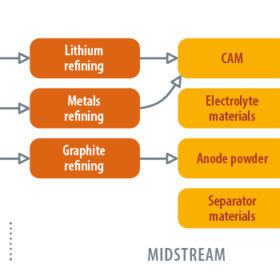
Battery supply chain state of health
As the US Uyghur Forced Labor Prevention Act demonstrated, companies preparing to spend big on batteries are at risk of being blindsided by supply-chain-related legislation. Here are some tips on how US developers can anticipate policy curveballs.

Solar may cover the world’s electricity demand with 0.3% of its land area
An international research group claims that raw materials and land availability do not present a real barrier for a global energy system with solar at its center. They said that forecasts for PV growth should not have their axis on utility-scale power plants and instead consider vertical PV, agrivoltaics, and floating PV as the source of future big market volumes.

LG unveils heat pump for water heating
LG has developed an air source heat pump with the capacity to heat 200 liters to 270 liters of domestic water. It uses R134a as a refrigerant and the pump has a coefficient of performance (COP) of up to 3.85.

The Hydrogen Stream: World’s largest hydrogen airplane makes first flight
ZeroAvia tested its new 19-seat hydrogen-powered aircraft, Chinese scientists unveiled new tech to promote bubble removal in electrolyzers, and Egypt-Japan University of Science and Technology researchers claimed that the most efficient hydrogen production systems are based on waste heat.
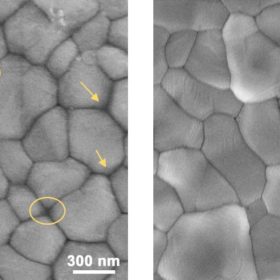
New ‘cushion’ solution to take stress off perovskite solar cells
Scientists in Germany have discovered a polymer compound that, when added to perovskite thin-film precursor materials, wraps itself around the perovskite crystals, acting as a cushion to protect the perovskite structure from thermomechanical stress. They used the additive to fabricate cells with up to 24.6% efficiency, retaining 96% of their initial performance after accelerated testing equivalent to one year in the field.

The fastest energy change in history
Solar and wind are being installed at a rate that is three times faster than all other new electricity sources combined. This offers compelling market-based evidence that PV and wind are now the most competitive and practical methods for deploying new generating capacity.

Ready for takeoff
Airport PV can provide an instant boost to emission-reduction efforts while work continues on sustainable aviation fuels. Developing solar projects at or near airports, however, is not as straightforward as typical ground-mount installations.

US startup unveils saltwater flow battery for large-scale storage
US-based Salgenx has developed a scalable redox flow battery with two separate tanks of electrolytes, one of which is saltwater. Unlike other flow batteries, the new device is membrane-free, promising big gains at the levelized cost of storage level.
