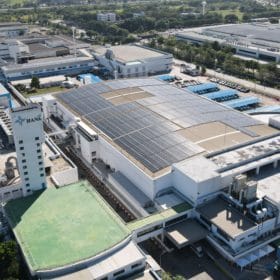
Solar on new-build homes has significantly shorter payback period
A report by BloombergNEF and Schneider Electric has pressed the case for governments to unlock the world’s potentially huge rooftop solar potential, and cited California’s solar mandate as a shining example.
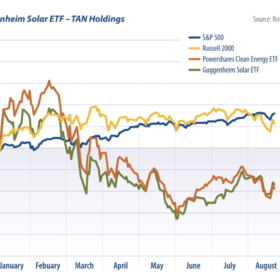
Guggenheim Solar Index: PV supply chain shake-up
Solar stocks have underperformed in the broader market in August, writes Jesse Pichel of ROTH Capital Partners. Project delays could be on the horizon as more module imports are held up at customs, and the supply chain will start to see impacts as suppliers look for options to source polysilicon outside of China.
The Hydrogen Stream: work begins on Chile’s first green hydrogen project and French energy giants target decarbonized hydrogen
TotalEnergies wants to decarbonize hydrogen production in Normandy with the support of Air Liquide and, in Chile, an international consortium has begun construction of the country’s first green hydrogen facility. Elsewhere, the Indian government has invited U.S. companies to bid for green hydrogen and electrolyzer contracts.
Is it time for the world to start thinking about 1.7C?
A note issued by Norwegian analyst Rystad has hinted it may be time to consider abandoning the 1.5-degree average global temperature rise ceiling agreed upon in Paris six years ago, because the world will never be able to pump out enough solar panels in time.
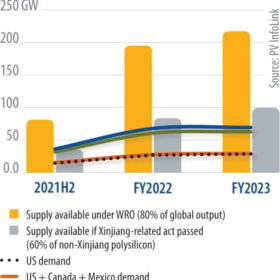
Polysilicon amid international trade disputes
Polysilicon capacity is unable to catch up with rapid capacity expansion in the mid and downstream segments, writes Corrine Lin, chief analyst for PV InfoLink. New polysilicon capacity requires big capex investment and a lead time of more than two years to complete construction and reach full operation. With unbalanced capacity between the upstream and downstream segments, polysilicon prices have been rising since the second half of 2020, with prices for mono-grade polysilicon surpassing CNY 200/kg ($27.40) in June 2021, up more than 250% year on year.

Keeping track of chlorine in perovskite stability
Scientists in Japan delved deep into the crystalline structure of a perovskite solar cell in order to understand how chlorine helps to improve the cells’ stability. By varying the concentration of chlorine in the material they were able to find an optimal level for increased stability, and open new doors on the way to understanding the specific role of chlorine and the mechanism behind the improvement.
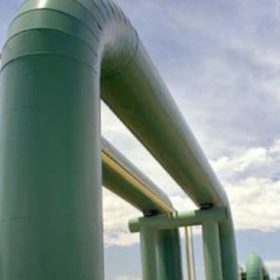
The Hydrogen Stream: An electrolysis test field in Germany and a deal for 500 hydrogen-powered electric trucks
Enertrage and Sunfire want to build an electrolysis test field in eastern Germany and Hyzon Motors sold 500 hydrogen-powered electric trucks to Shanghai Hydrogen HongYun Automotive. Moreover, several partnership agreements were announced in Malaysia, Japan, the US, Australia and South Korea.
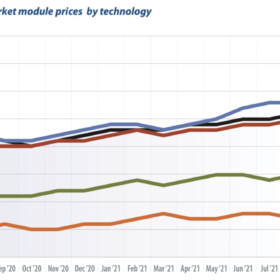
EU spot market module prices: PV prices high today, higher tomorrow
Some time ago, when I lived in the center of Berlin, I was a regular at the farmers’ market to buy fresh fruit and vegetables. One greengrocer advertised his wares with the words “cheap today, expensive tomorrow.” It would almost be desirable if we PV wholesalers could offer our modules with a similar slogan. Unfortunately, no one in the industry can currently claim that solar modules are cheap – quite the opposite. Following a brief respite, prices have climbed again in recent weeks. Since the previous low in September 2020, prices for new, grade-A goods have already risen by an average of 20% to a level not seen since April 2019.
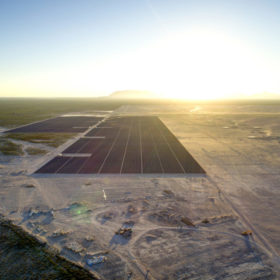
The world’s largest solar power plants
In his second article, Philip Wolfe founder of Wiki-Solar lists the world’s largest individual solar PV power plants. The biggest solar parks and other clusters of plants will be listed in subsequent blogs.
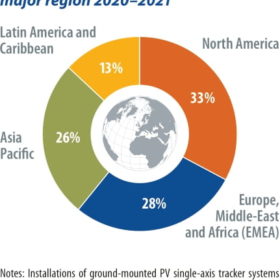
Global tracker shipments reached 45 GW in 2020
The global single-axis tracker market increased shipment volume by 40% year on year to reach 45 GW in 2020. This was despite significant pandemic-related supply chain turbulence that resulted in longer lead times for the delivery of components, the idling of steelmaking capacity in some key markets, container shipping dislocation, and widespread restrictions, particularly at ports. Most notably, this caused the cost of some commodities, such as steel, to more than double between 2020 and 2021. Jason Sheridan, a senior research analyst for IHS Markit, runs through some of the key developments in the tracker market.
