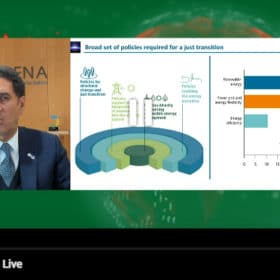
Global temperature goal of 1.5C needs 14 TW of solar by mid century
Renewable electricity will be linked to 90% of the actions needed to remove carbon emissions in 2050, according to the International Renewable Energy Agency, and the biggest volume of generation capacity will be provided by solar.
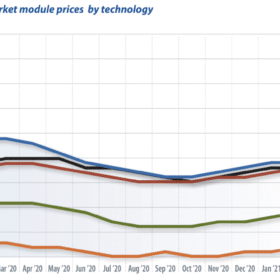
Why human rights protection is pushing up PV module prices
The solar industry typically sees itself as being supportive of the environment, humanity, and human rights. Even large Chinese PV manufacturers publish statements to this effect, particularly if they are listed on Western stock exchanges. But what do human rights have to do with the solar industry? What connections exist, asks Martin Schachinger of pvXchange, and how are they important to the future success of the European PV market?
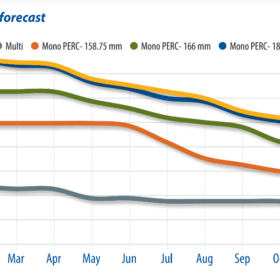
Manufacturing amid market concentration
The solar market is expected to grow in 2021, following a year of pandemic-driven supply chain disruptions, exacerbated by explosions at polysilicon plants. PV InfoLink estimates almost 154 GW of module demand in 2021, up by 10% on 2020. Analyst Amy Fang examines the key market trends for the first quarter.
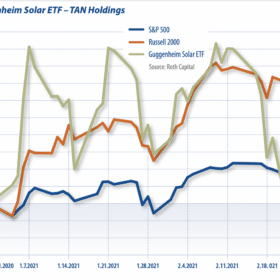
Guggenheim Solar Index: Headwinds, or a healthy correction?
In the month of February, the solar industry witnessed a decline, writes Jesse Pichel of ROTH Capital Partners. Increasing prices throughout the supply chain and forced labor concerns from China spelled headwinds for the solar industry, but the decline can also be viewed as a healthy correction, following historic highs in January.

Focus on temperature to reduce LCOE, says new study
A new model to assess the role of module temperature in PV power plant economics, developed by scientists in Saudi Arabia, finds that keeping modules cool could be an even more effective strategy to increasing energy yield than pursuing further gains in cell efficiency. The model finds that reducing module temperature by three degrees has a similar impact on energy yield to a 1% increase in conversion efficiency.
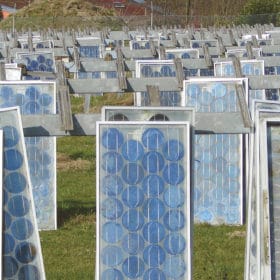
Reusing PV modules poses opportunities and challenges
In a new study, PV Cycle and Imec/EnergyVille examine the growing PV module reuse sector and detail both the opportunities and challenges of employing second-hand systems, especially in developing countries.
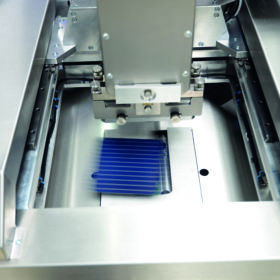
Simulating PV’s silver future
Scientists at Germany’s Fraunhofer ISE developed a model to simulate different setups for screen printing in solar cell metallization. The model provides a comparable ‘screen utility index’ value that can predict the usefulness of different architectures in the printing equipment in relation to the properties of a given silver paste. The approach, says Fraunhofer, will assist the PV industry in reducing the amounts of silver needed in silicon cell manufacturing.

Guessing game with 1,550 PV outcome scenarios
Swiss scientists have analyzed scenarios to predict the role of PV in the global energy mix by 2050 and have found that European entities expect a sharply higher compound annual growth rate than their Asian and North American counterparts. They also noted that the growth scenarios of the Intergovernmental Panel on Climate Change are more conservative than other predictions.
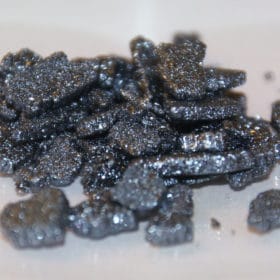
Inverted blade-coated perovskite cell with 23.2% efficiency
A US research team has improved the efficiency of a blade-coated perovskite cell with a p-i-n structure by reducing iodine-induced charge traps in the films. They used the cells to fabricate a mini module with an efficiency of 18.2%.

Silver accounts for 10% of PV module costs
The share of silver in the total cost of PV modules has increased by around 5% in recent months, according to US analyst Matthew Watson. He told pv magazine that silver prices are set to rise, adding that the metal will eventually account for an even larger percentage of overall module costs.
