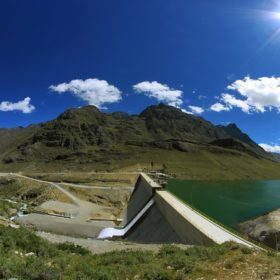
NREL scientists estimate global potential of hydro-linked floating PV at up to 7.5 TW
The U.S. based researchers said linking solar with hydro in a full hybrid system configuration may result – at best – in the deployment of 7,593 GW for an estimated annual power generation of 10,616 TWh and a 20% reservoir coverage. And combining solar with hydro in this way brings further benefits, including improved system operation at different time scales, more opportunities for storage thanks to pumped hydro, increased utilization rates of transmission lines, reduced PV curtailment, and lower interconnection costs and water evaporation.
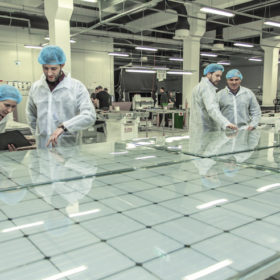
The weekend read: Materials in the circular economy
A number of companies are now racing to find new materials to replace toxic or otherwise unsafe elements in PV modules, in pursuit of circular economic ideals. In a similar vein, many researchers are also looking for ways to recycle and reuse some of these materials at the end of solar panel lifetimes. In line with these efforts, artificial intelligence and machine learning now play a critical role in identifying new chemical footprints for PV modules and cells.
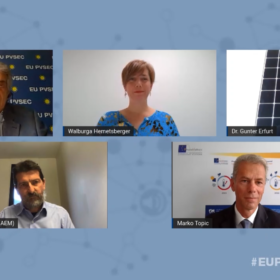
EU PVSEC 2020: Five takeaways
Spread across this week, the 37th EU PVSEC conference brought together companies and research institutes from Europe and further afield. This year’s presentations point to an industry standing at a crossroads. New challenges lie ahead, but there is plenty of optimism surrounding continuing growth and a more central role for PV in energy systems over the next decade. As the conference drew to a close on Friday, pv magazine offers five key takeaways.

‘Energy transition requires us to do things better’
The annual EU PVSEC conference got under way virtually this morning via an online platform since the planned event in Lisbon could not go ahead due to the Covid-19 pandemic. Opening presentations revealed an air of optimism in the PV industry, amid expectations of a rapidly rising share in the energy mix, growing conversion efficiencies, advancing technology pathways and innovative solutions to the problem of integrating high levels of PV into electricity grids.
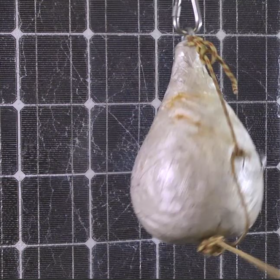
Light and shade of 500 W plus solar panels – part IV
In the fourth and final article of a series, pv magazine editor Pilar Sánchez Molina analyzes with industry experts challenges and opportunities created by new panels with power output exceeding 500 W.
Hydrogen economy needs public policies
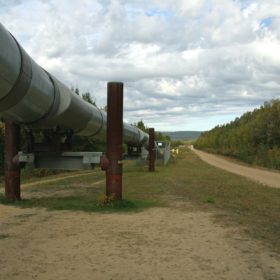
According to the 2020 Global Gas Report by Snam, the International Gas Union and BloombergNEF, public policies are required to support clean hydrogen reach industrial clusters and to facilitate large-scale use. The authors of the report acknowledged the advantages of using wind and solar to directly power electrolysis, but they do not discard the possibility of using gas power with carbon capture storage. The experts of the three parties also identified barriers to remove for future development.

Light and shade of 500 W plus solar panels – part III
In the third article in a series, pv magazine editor Pilar Sánchez Molina and industry experts continue their discussion on the challenges and opportunities created by new panels with power output exceeding 500 W.
A cell so thin, it can rest on a soap bubble
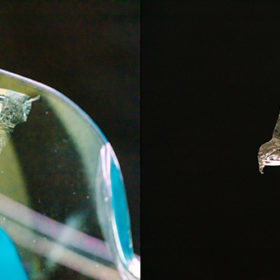
Scientists at Saudia Arabia’s King Abdullah University of Science and Technology demonstrated an organic PV cell that can simply be printed onto a piece of paper. The cell set a new efficiency record for a fully inkjet-printed device, and its designers envisage applications in integrated medical sensors.
Light and shade of 500 W plus solar panels – part II
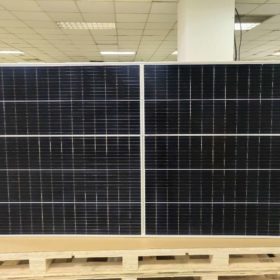
In the second article in a series, pv magazine editor Pilar Sánchez Molina and industry experts keep discussing the challenges and opportunities created by new panels with power output exceeding 500 W.
The weekend read: Hydrogen and the energy transition
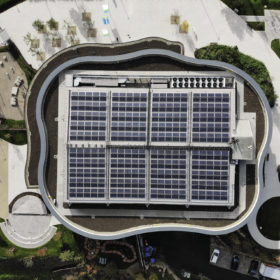
Researchers are now simulating how the energy transition can be as successful and cost-effective as possible. As part of the simulation, they are also calculating how much hydrogen will be needed and where it could come from. In Germany, a recent study by Fraunhofer ISE showed that the cost is so low that the nation could gift itself the energy transition as a Christmas present.
