
Enel touts €1bn green bond and bags 70% of Polish demand response market
The energy giant’s finance subsidiary placed a bond in Europe to finance its renewable energy and infrastructure projects and secured 70% of Poland’s demand response capacity market for the 2021-2023 period, in the first auctions of their kind in the nation.
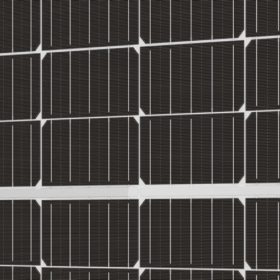
Webinar Q&A: “Are half-cut cell modules the future?”
Many manufacturers are converting large parts of their production capacities to half-cut cell technology. Is this a niche or will the traditional full cell module eventually disappear? The use of the new technology has clear advantages for manufacturers and buyers, say the experts.

PV rooftop simulators may unlock solar growth in developing cities
IRENA says technologies for 3D rooftop footprint generation and solar irradiation modelling are becoming increasingly cheap, making them suitable for deployment anywhere in the world. Developing cities across Africa and Asia could access such technical resources to plan rooftop PV development.
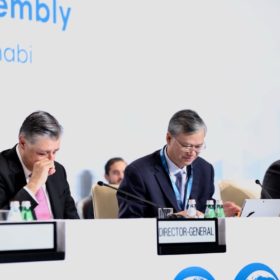
Italian climate negotiator selected as head of IRENA
Italian COP negotiator and environmental public servant Francesco La Camera has been selected as the International Renewable Energy Agency’s (IRENA) new director-general. He takes over from Adnan Z Amin, who stepped down from the role after eight years with an heartfelt parting address.
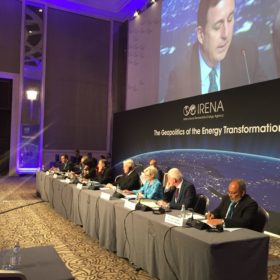
IRENA: Energy transition will see geopolitical “winners and losers”
The International Renewable Energy Agency has plotted the potentially dramatic impacts of a global transition to renewable energy from fossil fuels. Today’s A New World report notes the transition requires international cooperation to manage disruption, as it will leave behind countries and industries that fail to adapt.

Analysts expect stable prices along the PV value chain
Energy trend and PV Info Link assume little movement in prices for silicon, wafers, solar cells and modules in the coming weeks. The capacity adjustments of solar manufacturers, however, are set to continue.

Solar money is all flowing downstream – in the West at least
Mercom Capital’s latest report on financial activity in the solar sector illustrates an increasing flow of capital towards downstream companies and PV projects – as well as a split between China and the rest of the world.
New products contribute to another record year for sustainable finance
BloombergNEF figures show financial vehicles linked to environmental and/or social benefits amounted to $247bn worldwide in 2018. The US led the way, almost entirely because state-backed mortgage provider Fannie Mae issued $19.8bn worth of green home loans.

GSC wants 1 billion mini-grids, 10 million solar jobs
“One billion mini-grids, one billion home lighting systems, one billion solar PV ports, 10 million jobs and energy for all have-nots around the world. This is the primary dream of the Global Solar Council (GSC) and we shall achieve this by 2030,” Pranav R Mehta, who took over as chairman of Global Solar Council today, told pv magazine in an exclusive interview.

14 PV trends for 2019
Having reflected on the year gone by, it is time to turn attention to the coming year. Many predictions may not fully, or even partially, bear the fruit they promise – and the unexpected is always lurking in the background – however they can be a useful indicator of certain pathways and growth areas. With this in mind, the pv magazine team has compiled a list of the top 14 solar PV and energy storage trends expected to characterize 2019. What do you think? Have we missed anything?
