
Zurich launches insurance for agrivoltaics
Zurich Group Germany has introduced a modular insurance product addressing crop, livestock, and equipment risks on land used for simultaneous farming and solar power generation.

Agrivoltaics for arboriculture
Swiss company Insolight inaugurated a 250 kW agrivoltaic installation on apple, pear, and apricot orchards in Conthey, producing 300 MWh per year for the grid, in collaboration with Agroscope, Romande Energie, and the canton of Valais.
Uncovering attitudes towards agrivoltaics via community engagement
An American research group has conducted a pilot workshop for agrivoltaics stakeholders in Arizona, including farmers, developers, government officials and indigenous leaders. A reflection paper offers some key takeaways for future public participation.

Germany’s largest agrivoltaic project goes online
Vattenfall has commissioned a 76 MW agrivoltaic plant in Germany under a long-term power purchase agreement (PPA) with a subsidiary of Deutsche Telekom AG.
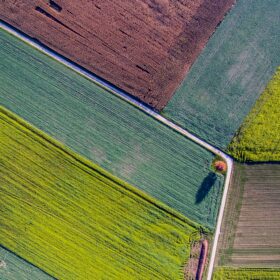
Decision making tool for crop selection in agrivoltaics
Researches in Germany have created a comprehensive crop selection tool for agrivoltaics across more than 25 countries. The proposed matrix evaluates species-specific responses of 12 major crop types to shading, microclimate changes, and crop growth, while also assessing their water needs, shade tolerance, and space requirements.

Agrivoltaics for sugarcane
Brazilian scientists have investigated the potential of agrivoltaics on sugarcane fields and have found this combination may provide benefits in terms of both agricultural and electricity yield. Their results showed that under certain conditions the sugarcane yield below the panels can be higher than that of plots without PV.

Agrivoltaics on rice fields, not a lost cause
Researchers in Japan have made another attempt to make agrivoltaics on rice fields technically and economically feasible, despite well-known productivity issues when rice is grown below solar modules. They used double-axis tracking, finding potential with careful management of shading and tilt angles.
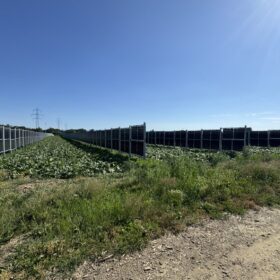
A closer look at vertical agrivoltaics
pv magazine visited a 1.9 MW agrivoltaic plant in Austria where pumpkins and soy are cultivated beneath vertically mounted PV structures supplied by Next2Sun.
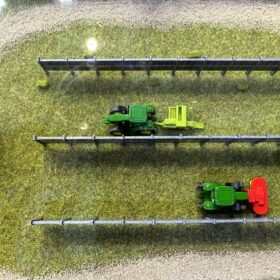
What standards for agrivoltaics?
The technology which combines solar PV panels and agriculture is gaining ground. IEC Standards for solar photovoltaic (PV) systems already exist, but more might be required, dealing with some of the more specific issues relating to agriculture.
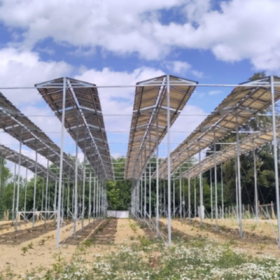
Fraunhofer ISE estimates Germany’s agrivoltaic potential at 500 GW
Fraunhofer Institute for Solar Energy Systems (ISE) says Germany could deploy up to 500 GW of agrivoltaic capacity, based on a nationwide assessment of all agricultural land types and site suitability criteria.
