Mining giant unveils AU$73m solar-plus-storage project
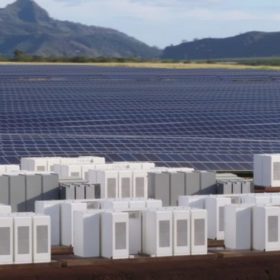
Mining giant BHP has taken another step on the path towards a renewable energy future, commissioning a 48.2 MW solar-plus-storage hybrid power facility that will help power its Nickel West mining operations in regional Western Australia.
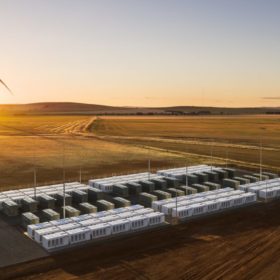
Australia’s energy storage installed base to grow more than five times by 2030
In its latest report, IHS Markit predicts that energy storage installations in Australia will grow from 500 MW to more than 12.8 GW by 2030. Today, Australia makes up less than 3% of total global installations for battery energy storage and is the seventh largest market globally. By 2030, it is forecast to comprise 7% of global installations and become the third largest market. This growth will be largely driven by three distinct market segments: residential, standalone front-of-the-meter, and collocated with utility-scale renewables.
Battery testing builds certainty
Owners and operators of energy storage systems, as well as investors, need transparent ways to evaluate battery performance. They need certainty that the selected batteries for their ESS projects will perform reliably, have predictable life expectancies, and meet projected revenue and contractual obligations over their lifetimes. The economic viability of entire projects depend on this confidence, writes Michael Kleinberg of DNV.
Saft opens 480 MWh battery manufacturing hub in China
The company is answering the growing demand for storage systems in virtually all markets. China itself is on a steep trajectory to increase its deployment rate.
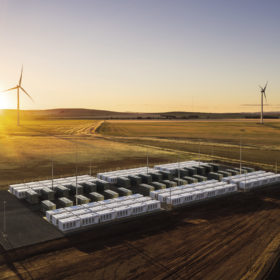
Lake Bonney big battery ready to supply Tesla’s Australian EV charger network
The 25 MW/52 MWh battery at the Lake Bonney wind farm is in the final stages of testing. Once operational, the big Tesla battery will supply the electric carmaker’s Australia EV supercharger network with renewable electricity.
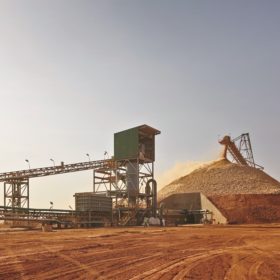
Burkina Faso gold mines to get 13 MW solar-plus-storage
Renewable energy is rapidly being adopted by mining companies as the combination of off-grid power and cheaply available renewables offers a strong business case.
Lyon Group, China Huadian, Jera join forces in war on curtailment
Solar infrastructure developer Lyon Group has launched a joint venture with two Asian energy generators to use integrated battery storage systems to reduce curtailment risks and increase the flexibility of renewable energy plants in the Asia-Pacific region.
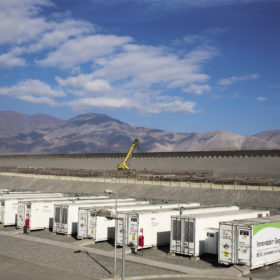
The weekend read: Chile taps ‘white gold’ for security of energy supply
Chile is home to a massive 10.3 million tons of lithium reserves, most of which is found in the Atacama Desert in the northern part of the country. With some of the highest solar irradiation levels on Earth, this region also boasts the perfect conditions for generating solar power. Developments in the photovoltaic market, alongside implementation of more efficient energy storage systems, are positioning Chile as a regional leader in this field. So what does the future hold for battery energy storage systems (BESS) in Chile, and what obstacles lie in their way?
REIL tenders 1.7 MW PV+storage projects in India’s Andaman and Nicobar Islands
Rajasthan Electronics & Instruments (REIL) has invited bids to set up 1.7 MW (AC) of grid-connected PV projects with battery storage in India’s Andaman and Nicobar Islands. The projects — to be implemented on a turnkey basis on Havelock Island (Swaraj Dweep) and Neil Island (Shaheed Dweep) — will be awarded through competitive bids, followed by a reverse auction.

Munich Re’s new policy could help lever solar investment
Insurance is seldom sexy but climate change campaigners will raise a glass to Munich Re if the industry emulates its policy to cap the financial risk related to battery warranties and helps lift global investment in energy storage as a result.
