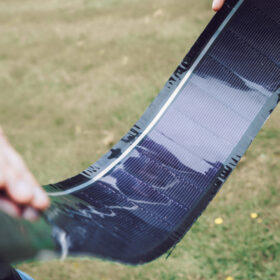
Belgian startup offers custom CIGS solar foils
Enfoil is developing a CIGS thin film custom manufacturing business, targeting building-integrated PV applications, such as powering sensors or track & trace sub-systems in trucks. The company is a spinoff of Hasselt University and imec, the Belgian research institute.
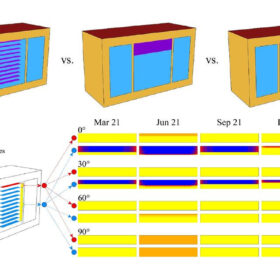
How to maximize power generation in PV blinds
Scientists in South Korea have stressed the importance of accurately setting the angle of slat PV blinds to maximize power generation. They found that there is a tradeoff between elevated power yield and self-shading effects in this BIPV technology.
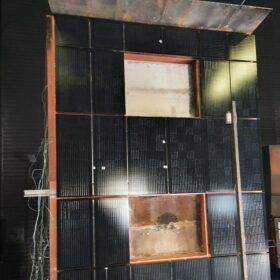
Addressing the intricacies of BIPV fire safety
The adoption of building-integrated photovoltaics (BIPV) has been hindered by the complexity of fire safety standards, creating challenges for manufacturers and suppliers. However, efforts such as the IEA PVPS Task 15 report and collaborative research have shed light on the importance of comprehensive guidelines, reliable testing laboratories, and international cooperation.
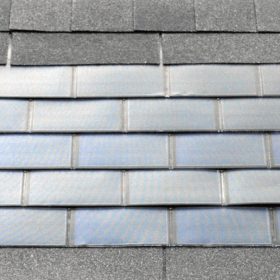
Roof-integrated solar takes 44% less time to install, says NREL
The National Renewable Energy Laboratory (NREL) conducted a time-motion study and found that retrofitting roof-integrated PV requires 7% less labor than standard solar installations. For new builds, installation times fall by 44%.
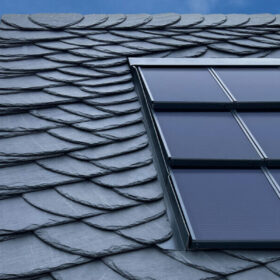
Meyer Burger unveils gray solar tiles
Swiss manufacturer Meyer Burger says that in August it hopes to begin distributing its new gray solar tiles, which are already being used in pilot projects.
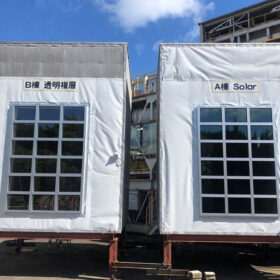
Japanese consortium demonstrates transparent PV windows in indoor environment
Nippon Sheet Glass (NSG), Japan’s largest glassmaker, plans to show photovoltaic windows developed by its US unit, Ubiquitous Energy, at a train station in Japan. The windows feature a transparent photovoltaic coating with an invisible element of power generation, capable of absorbing non-visible wavelengths.
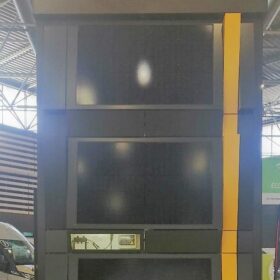
French startup unveils aluminum solar facade
C2F has developed a building-integrated PV (BIPV) facade made of aluminum that purportedly limits the impact of hot and cold weather, while also improving solar module performance.
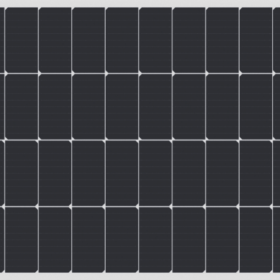
GoodWe releases 315 W BIPV panels with 17.4% efficiency
GoodWe will initially sell its new 315 W building-integrated PV (BIPV) modules in Europe and Australia. They measure 2,319 mm × 777 mm × 4 mm and weigh 11 kg.
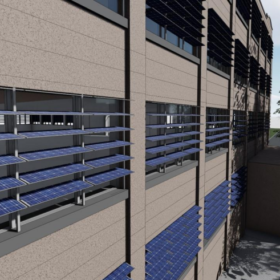
Design framework for BIPV shading devices
Canadian researchers have developed a new model to improve the performance of building-integrated PV (BIPV) shades in buildings. They considered solar electricity, heat transferred through windows, and interior daylighting quality.
TÜV Rheinland offers certification for building-integrated PV
Germany’s TÜV Rheinland has defined safety and quality guidelines for building-integrated photovoltaic (BIPV) modules to bring more transparency to the market.
