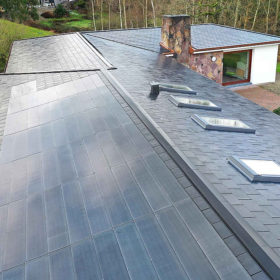
New solar tiles from Denmark
Danish BIPV specialist Dansk Solenergi has added two more tiles to its product range – an 18.15%-efficient dark grey panel and a 16.7%-efficient terracotta product. Both panels have an operating temperature coefficient of -0.34% per degree Celsius.

France provides incentives to landscape-integrated BIPV
The French authorities have so far selected four BIPV products that are eligible for the incentive scheme.
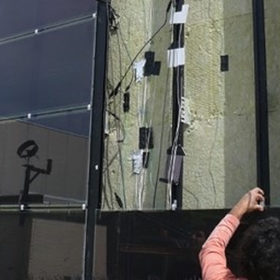
Photovoltaic forced ventilated facade for applications with air source heat pumps
Scientists in Spain have designed a BIPV forced ventilated facade that can be used as support for heating and a domestic hot water (DHW) building system based on air source heat pumps (ASHPs). In the proposed system configuration, the heat pump is expected to cover building heating demand at all times, regardless of the performance of the solar array.
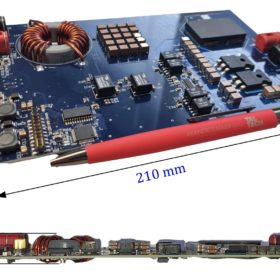
Novel power electronic converter for BIPV
Conceived by researchers in Estonia, the device is claimed to be compatible with both crystalline silicon and thin-film BIPV panels and to manage, easily, different voltage levels. It can be applied either in solar facades or BIPV rooftop arrays.
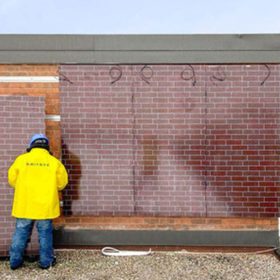
Mitrex releases solar brick for BIPV facades
Mitrex solar facades are being installed on a 7000 square feet area on a building in Canada, producing an estimated 90,000 kWh of power annually.
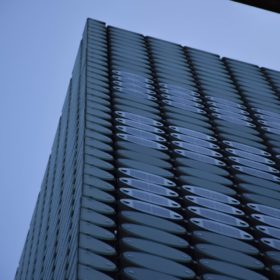
The best BIPV envelope design alternatives
Scientists in Australia have developed an optimization framework for building-integrated photovoltaics that allows the selection of design variables according to user preferences. Their model considers PV-related features such as tilt angle, window-to-wall ratio (WWR), PV placement, and PV product type, as well as objective functions and constraints such as the net present value and the payback period.
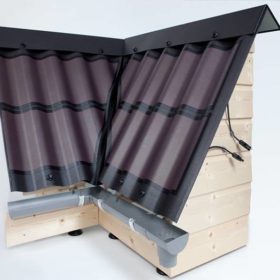
Solar foil for BIPV applications
HyET Solar and the Delft University of Technology are developing a photovoltaic foil technology that is claimed to be suitable for any type of surface. The solar foil has a 12.0% conversion efficiency and is based on hydrogenated amorphous silicon and nanocrystalline silicon in a tandem cell configuration.
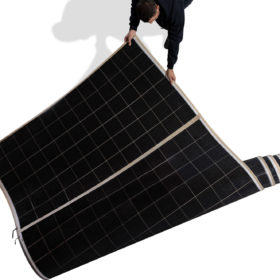
Flexible solar panels made in Israel for Amazon’s facility in France
Apollo Power is providing its flexible solar modules for a €750,000 photovoltaic project planned by Amazon in France. Each of the module units provided by the Israeli manufacturer has a size of 2,040×6,130mm and weighs in at only 3kg/m².
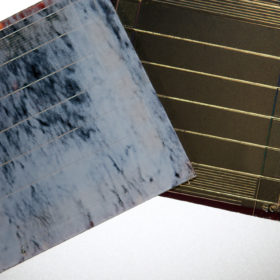
Small-area, colored perovskite BIPV module with 13.9% efficiency
Through a conventional coloring technique for crystalline solar modules, scientists in Germany were able to manufacture a colorized small perovskite solar module in white marble optic displays that maintains up to 88.5% of the efficiency it had before coloring. The device was built with five cells interconnected in series and has a total area of 9cm2.
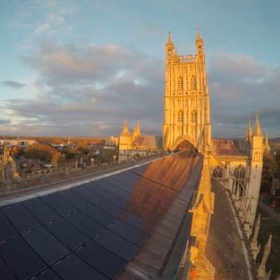
Solar for churches
Churches use energy mostly during the day, which makes them ideal buildings to deploy solar panels. Scientists in the United Kingdom have assessed the financial viability of a rooftop PV project for Bath Abbey and found that it could become profitable after 13 years.
