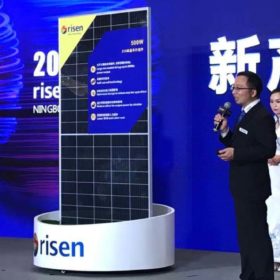
Chinese PV Industry Brief: a 15 GW factory, new standards and solar glass output
Risen Solar has unveiled plans for a 15 GW cell and module fab in Yiwu City, Zhejiang province and China South Glass is fundraising for a PV glass factory in Anhui province. Such growth, however, may be slowed by the introduction of new standards by the government.
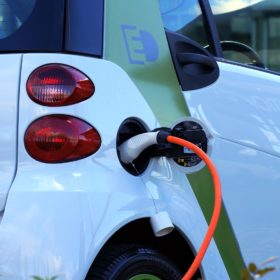
Demand for gas-guzzling SUVs surges in China as electric car sales plummet
The market last month saw a sharp rebound in the sales of traditional, internal combustion engine vehicles as Covid-19 restrictions continued to ease. Analysts have predicted a similar rebound in Europe as the continent emerges from the public health crisis.
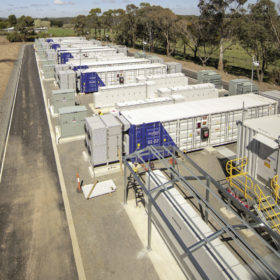
China reaches 1.7 GW of electrochemical storage capacity
According to new numbers released by the China Energy Storage Alliance, the country’s storage capacity topped 32.4 GW at the end of last year. The association said the storage market is expected to continue to grow steadily in the years ahead.

Covid-19 weekly briefing: Merchant solar developers could seek shelter in return to subsidies and PPAs are being revisited, but at least the Irish are coping with lockdown measures
The unfolding effects of the Covid-19 crisis, and fears of a possible second wave, have split analysts trying to guess how the unsubsidized renewables market will emerge as slumping demand continued to distort power markets. pv magazine rounds up the week’s coronavirus developments.
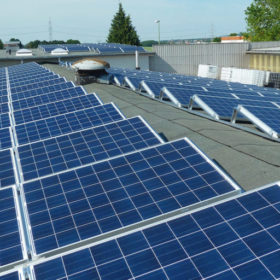
Germany has 200,000 solar-plus-storage systems
EuPD Research estimates around 65,000 energy storage systems linked to rooftop PV were installed last year thanks to increasingly popular solar arrays and electric vehicles as well as rising electricity prices.
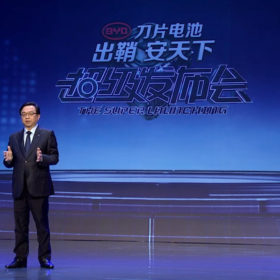
BYD launches Blade Battery for improved fire safety in electric vehicles
During an online launch event, a Blade Battery pack was pierced with a nail without becoming unstable or experiencing dangerous high temperatures. The company says the device will be safer during car accidents.

Renewables developer and EV maker join fight against Covid-19
Spanish clean energy company Grenergy has donated 55,000 pieces of Chinese-made personal protective equipment to the authorities in Madrid and electronics and e-mobility company BYD this month opened the ‘world’s largest mass-produced face masks plant,’ in Shenzhen.
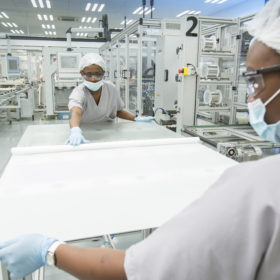
Module manufacturer responds to rumors of panel failures at 75 MW South African project
Reports of module under-performance at the Mulilo Sonnedix Prieska solar project have prompted a response from South African company Artsolar, one of the module suppliers for the plant. The project is said to be experiencing serious problems due to premature module degradation. Divian Govendar, CEO of Johannesburg-based Artsolar, said the company has not been required to replace any modules at the site.
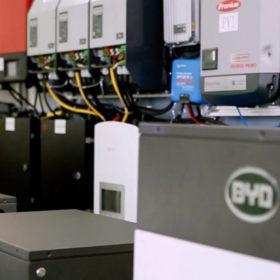
BYD to introduce next-generation Battery-Box in 2020
The Chinese manufacturer has also announced plans for a tenfold production capacity increase, as it wants to cater to all project sizes with two versions of its high-voltage storage system.
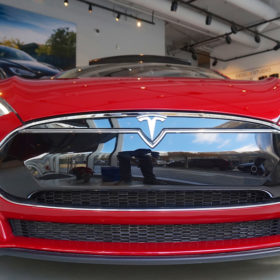
Tesla gigafactory orders see LG Chem supplant BYD as third biggest global battery supplier
The Chinese e-mobility company has been hammered since Beijing’s abrupt reduction of electric vehicle subsidies in the summer. Korean outfit LG Chem’s shipment volumes have gone in the opposite direction.
