UK researchers developing new type of cadmium telluride PV panels for space applications
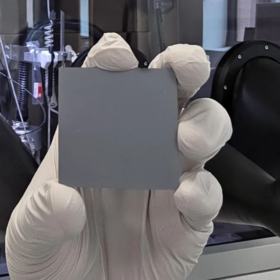
A team of UK researchers is working on lightweight cadmium telluride (CdTe) solar devices for space arrays. The aim is to develop 20%-efficient ultra-thin devices to provide lightweight, compact, lower cost solar power for satellites and space-based manufacturing applications.

EU updates Photovoltaic Geographical Information System
The EU Joint Research Centre (JRC) has updated the core technologoy of the Photovoltaic Geographical Information System with the aim of reflecting the dominance of crystalline silicon solar technologies over thin-film counterparts in the global energy market.

First Solar ships 14.1 GW of thin-film solar modules in 2024
First Solar delivered 14.1 GW of thin-film solar modules in 2024, driving $4.2 billion in revenue. The US cadmium telluride panel maker now faces global policy uncertainty.

Juniper Green places 1 GW PV module order with First Solar
Juniper Green Energy has signed an agreement to buy 1 GW of First Solar’s Series 7 FT1 cadmium telluride (CdTe) thin-film PV modules. The modules will power projects in the Indian states of Rajasthan, Gujarat, and Maharashtra.
Improving perovskite solar cell performance with cadmium telluride buffer layer
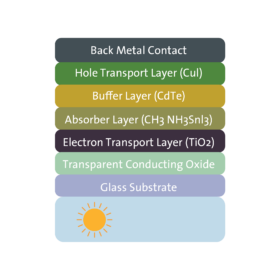
An international research team has conducted a series of simulations to investigate how a cadmium telluride buffer layer may help increase efficiency and stability in perovskite solar cells. Their experiment showed that cell efficiency may climb from 11.09% to 23.56%.
Increasing voltage in cadmium telluride solar cells through nickel oxide back buffer layer
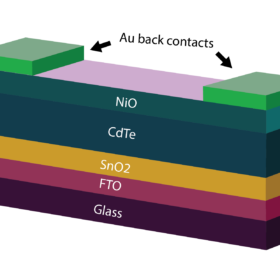
Cadmium telluride solar cells are commonly based on non-ohmic back contacts that affect the device open-circuit voltage. Researchers in the United Kingdom sought to address this issue by adding a nickel oxide back buffer layer, which formed an ohmic back contact and increased open-circuit voltage levels.

Semi-transparent PV window based on passive radiative cooling coating
Scientists have manufactured and analyzed a novel coating for semi-transparent photovoltaic glazing that reportedly offers remarkable energy yield and a low heat gain rate. Through outdoor experiments, the researchers also found the glazing also provides satisfactory high-quality indoor lighting conditions.

Shedding light on tandem perovskite solar cell progress
Perovskite PV devices are set to become the next big thing in solar with market analysts at S&P Global Commodity Insights predicting 1 GW of production by the end of 2024, rising to 6 GW in 2025. Perovskite tandem devices are at the front of the queue for commercialization but their characterization presents technical challenges.
U.S. scientists demonstrate 25%-efficient perovskite-cadmium tandem solar cell
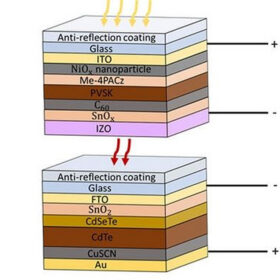
The researchers say the cell has a top perovskite cell with a transparent back contact made of indium zinc oxide and a commercially established cadmium telluride bottom device. They claim the champion tandem cell has the potential to reach a 30% efficiency.

India sets efficiency requirements for cadmium telluride solar modules
India’s Ministry of New and Renewable Energy (MNRE) has established minimum efficiency standards for cadmium telluride (CdTe) thin-film solar modules to qualify for inclusion on the Approved List of Models and Manufacturers (ALMM).
