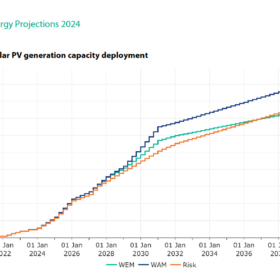
Ireland to miss 2030 solar targets by at least 2.9 GW, says SEAI
New data from the Sustainable Energy Authority of Ireland (SEAI) says there is no scenario in which Ireland will meet its 2030 solar deployment capacity of 8 GW. With existing measures in place, the reality would be more like 5 GW, the government-run group estimates.
UK capacity additions slow but major project pipeline grows
Government data records 17.1 GW of deployed solar capacity in the United Kingdom at the end of September 2024. New domestic installations are down on the same period in 2023, however, a growing pipeline of major projects with planning consent points to significant capacity gains in the future.

UK solar capacity hits 17 GW as government mulls PV planning reform
Greatest capacity uplift of 2024 recorded in July as provisional deployment data suggests 1.2 GW added over 12-month period. Domestic installations continue to account for the lion’s share of new additions, but the UK government is seeking views on planning reforms aimed at accelerating deployment of larger-scale solar farms.

United Kingdom closes in on 16 GW installed solar capacity
The latest government installation figures reveal a slower start to the year for the United Kingdom, with small-scale installations accounting for the majority of additions. As the UK General Election approaches, there are calls from industry for the next government to act quickly on the issues hindering capacity expansion.
2019 PV installations to hit 123 GW, global balance shifting, says IHS Markit
More predictions from IHS Markit reveal that 123 GW of solar PV installations are expected in 2019 – up 18% on the capacity additions expected this year. It also sees a market shift away from China, with two thirds of capacity located elsewhere. The overcapacity situation is also expected to ease.
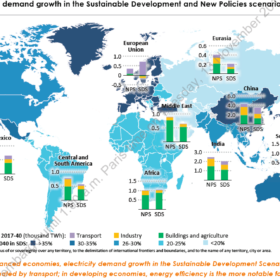
IEA World Energy Outlook: Solar PV capacity to overtake all but gas by 2040
Even in its low ball scenario, the International Energy Agency (IEA) imagines that installed solar PV capacity will overtake that of all other forms of energy apart from gas by 2040. Overall, it presents four scenarios in its 2018 World Energy Outlook, which show a changing energy landscape. While it finds that CO2 levels are, perversely, on the rise, and that many energy efforts in all but the most whimsical of its forecasts are far behind those needed to seriously address global warming, it still imagines coal, oil and gas playing a leading role in our energy mix going forward. It also sees “dramatic” transformation in the electricity sector. Long story short: Read something else if you want to take real climate action. We suggest The Drawdown.
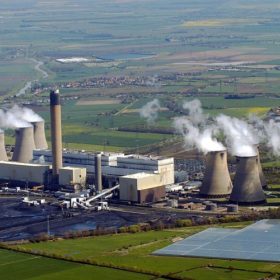
Renewables overtake fossil fuels in UK installed capacity
A report published today by U.K.-headquartered energy company Drax says that, for the first time ever, total generation capacity available from renewables has overtaken that of fossil fuels on Britain’s electric grid.
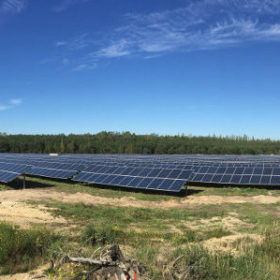
Germany adds 111 MW of solar in March
The German government will reduce FITs by 0.25% for the next months, although new additions are significantly behind the 2.5 GW annual target for solar.
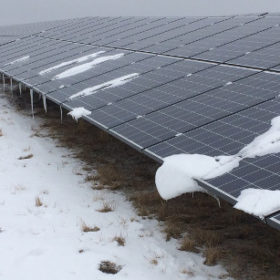
Germany registers 117 MW of new PV installations in January
Germany has registered 117 MW of new PV installations in January. The country’s cumulative PV capacity has reached approximately 41.34 GW.
