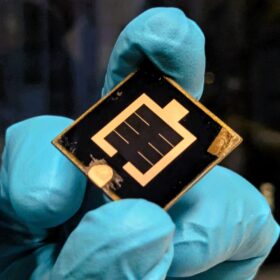
Helmholtz-Zentrum Berlin hits 24.6% efficiency for perovskite-CIGS cell
Germany’s Helmholtz-Zentrum Berlin (HZB) has achieved a world-record 24.6% efficiency rating for a perovskite-copper indium gallium selenide (CIGS) tandem solar cell. Germany’s Fraunhofer Institute for Solar Energy Systems (Fraunhofer ISE) has confirmed the result.
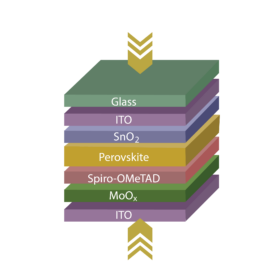
Chinese researchers build 4T perovskite-CIGS tandem solar cell with 29.36% efficiency
Scientists in China built a four-terminal perovskite-CIGS tandem solar cell based on a top semi-transparent perovskite device with an efficiency of 21.26% and a high bifaciality factor of 92.2%. They used a solvent-annealing strategy to produce a perovskite film with full coverage, larger grains, superior crystallinity and free of detectable lead iodide impurity.
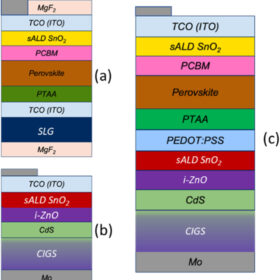
Two-terminal perovskite-CIGS tandem solar cells have technical potential to achieve 26.69% efficiency
A Dutch and U.S. research team performed optical and electrical simulations to understand loss mechanisms in two terminal (2T) tandem cells based on perovskite and commercially available copper-indium-gallium-selenide (CIGS) cells, and subsequently established a roadmap to increase efficiency via four key modifications.
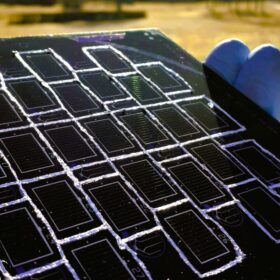
First Solar’s unit, Uppsala University present CIGS solar cell with world record efficiency of 23.64%
The new solar cell achieved a maximum power conversion efficiency of 23.75% and a certified efficiency of 23.64%, thus beating the previous world record of 23.35% achieved in 2019 by Japan’s Solar Frontier. The result was confirmed by the Fraunhofer ISE.
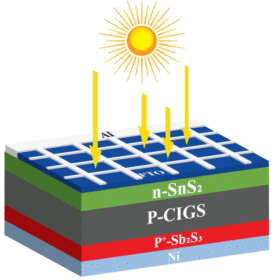
New CIGS solar cell design with antimony trisulfide promises 31.15% efficiency
The novel solar cell uses antimony trisulfide (Sb2S3) as the back surface field (BSF) layer. According to its creators, this layer can be included in conventional CIGS solar cells to improve their efficiency and reduce the absorber material’s cost.

Weekend Read: The fruitful search for other thin films
First Solar and its cadmium telluride (CdTe) technology dominate thin-film solar in the mainstream market. Valerie Thompson looks at the US-based business and the future of thin-film PV technology.
Ascent Solar announces 17.55% efficiency for CIGS tech
Ascent Solar, a US-based manufacturer, has achieved an efficiency of 17.55% for its copper, indium, gallium and selenide (CIGS) technology. It says it plans to release a new CIGS solar module with this efficiency rating soon.
Ascent Solar hits 15.2% efficiency in production trials for CIGS cell
Ascent Solar has achieved a 15.2% efficiency for a copper indium gallium diselenide (CIGS) cell in production trials by replacing cadmium sulfide with a new material in the manufacturing process.
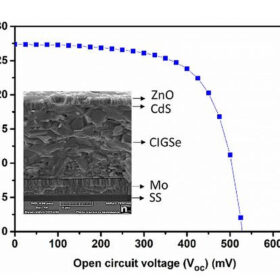
CIGS solar cell using aluminum doped zinc oxide film achieves 9.53% efficiency
Scientists have developed a technique for producing AZO and i-ZnO/AZO bilayer structures in solar cells that greatly improves cell efficiency and durability. Using a low power deposition method that avoids raising the substrate temperature, the team achieved a power conversion efficiency of 9.53% with good transmittance.

Avancis achieves 20.3% efficiency in CIGS solar panel
Avancis has set a new world record for a copper, indium, gallium, and selenium (CIGS) solar panel with an integrated series connection of 30 cm x 30 cm, achieving an efficiency of 20.3%. The German manufacturer’s accomplishment has been validated by the US National Renewable Energy Laboratory.
