North German pilot hydrogen project gets cash boost
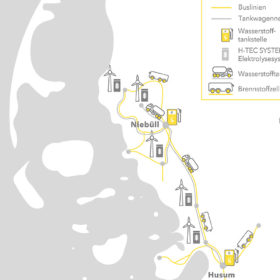
German company GP Joule wants to build hydrogen transport infrastructure in North Friesland. The electricity generated by five wind farms in the region will be converted to green hydrogen to be delivered to filling stations in Husum and Niebüll and used by two fuel-cell buses and five cars.
Eskom launches tender to ‘repurpose’ coal plants with low-carbon growth tech
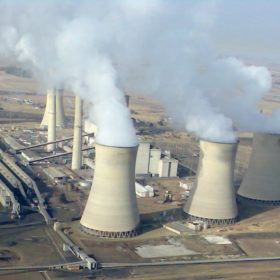
The debt-saddled South African utility has issued an expression of interest to seek proposals on how to refurbish three fossil fuel power plants to be decommissioned in the current decade. Eskom said that all of the proposed solutions should be at the tech-readiness level.
Global supergrid vs. regional supergrids
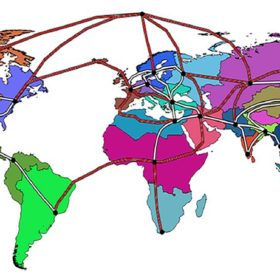
Researchers from Finland’s Lappeenranta University of Technology have assessed the economic advantages of a fully interconnected global network. They found that an international grid could contribute to a global LCOE of €52.50/MWh. The higher complexity of such a system, however, would only be marginally compensated by additional economic benefits.

More than 100 GW of solar in the Netherlands? Possible by 2050
Solar capacity is expected to grow to unthinkable levels in the tiny country, according to a new report by Netbeheer Nederland. Under one scenario in which regional governments and companies would take the lead in the energy transition, cumulative solar capacity could reach 125 GW. Under a second scenario, in which growth would be driven by the central government, total PV capacity could hit 106 GW.
Low-cost bio-inspired electrocatalyst for rechargeable metal-air battery
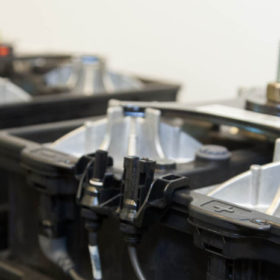
Indian scientists have developed a low-cost electrocatalyst based on iron, manganese and N-doped carbon derived from fish gills (Fe/Mn/N-FGC) to increase the performance of a homemade rechargeable zinc-air battery. The Fe/Mn/N-FGC cathode-based battery achieved open-circuit voltage of 1.41 V and a large power density of 220 mW/cm2 at 260 mA/cm2 current density – compared to 1.40 V and 158 mW/cm2 for a commercial platinum/carbon-based battery – with almost stable charge-discharge voltage plateaus at high current density.
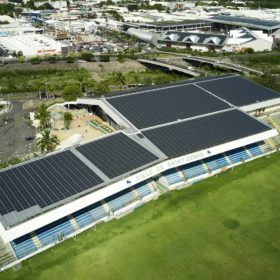
La Réunion stadium hosts 1.25 MW/1.33 MWh of solar-plus-storage
The project was selected in a tender for storage deployment in non mainland grid interconnected areas that was finalized by France’s Energy Regulatory Commission in 2016.
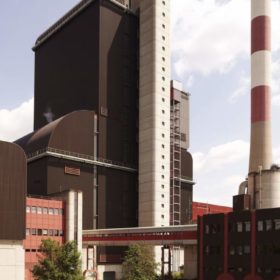
Austria’s last coal power plant shuts down
Austrian power provider Verbund has shut down its coal-fired district heating plant in the state of Styria as planned. This means that coal power generation in Austria is now history, paving the way for a switch to a 100% renewable power supply by 2030. However, Photovoltaic Austria emphasizes that Austria needs a well-considered plan for clean energy, as a quarter of the nation’s electricity is still generated from fossil fuels.
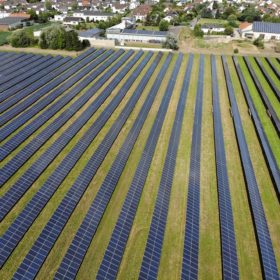
Would solar decarbonize French energy – or just replace nuclear?
A thinktank has studied whether increased solar energy would contribute significantly to reducing the carbon footprint of the French and European electricity systems in an attempt to respond to a common French refrain the nation needs no further decarbonization of energy because it has nuclear power.
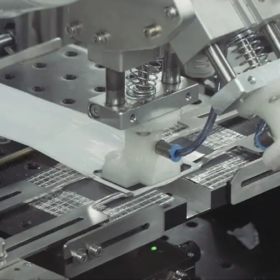
A non-flammable lithium metal battery
Researchers from Deakin University in Australia claim their battery chemistry is based on a new class of electrolyte material which carries no risk of uncontrolled thermal events and represents a viable alternative to rechargeable lithium-ion batteries.
Redox flow batteries for $66/kWh from steel industry waste
U.S. researchers claim to have added iron sulfate to anthraquinone disulfonic acid in a redox flow battery for the first time. The scientists said the combination could lead to inexpensive and more stable redox flow storage for just $54/kWh and said $66/kWh is already possible.
