Evaluating tandem cells, from the bottom up
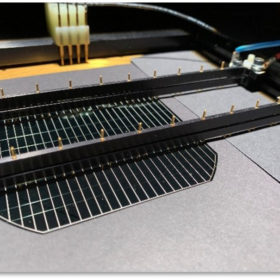
Scientists in Germany evaluated multiple silicon cell concepts based on both cost and efficiency in serving as the bottom layer in a perovskite-silicon tandem cell. The study, based on both simulation and experimental work, outlines advantages to various approaches with the silicon cell and concludes that in almost every case, perovskite-silicon tandem cells have the potential to bring solar costs down below what could be achieved with silicon alone.
How temperature affects tandem solar cell performance
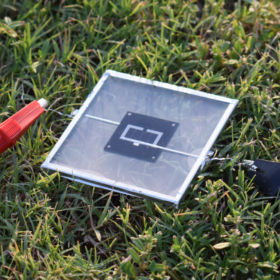
New outdoor tests conducted at Saudi research center King Abdullah University of Science and Technology (KAUST) have shown that an increase in temperature affects the performance of a tandem perovskite/silicon solar cell not only because of voltage losses but also because of current mismatch between the two sub-cells.

Copper metallization process reaches pilot production in Germany
Scientists led by staff from Germany’s Fraunhofer ISE have demonstrated a new laser printing process in pilot production, which could replace silver paste and screen printing in solar cell manufacturing. The system is said to offer much more flexibility in the layout of contact fingers on the cell surface and a wider choice of metallization materials.
Fraunhofer ISE solar cell manufacturing spin-off could reduce silver content
Highline Technology GmbH has a production process in which metal contacts are applied without touching the front of solar cells, reportedly saving resources and raising efficiency.
Fraunhofer ISE develops organic solar cell with 14.9% efficiency
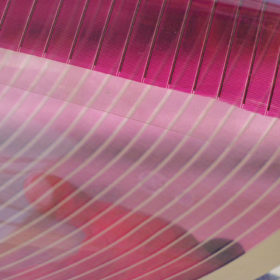
The record was obtained with a 1.1 sq cm device.

Intense pulsed light processing for 23.0%-efficient silicon heterojunction solar cells
Scientists at Germany’s Fraunhofer Institute for Solar Energy Systems (ISE) have used intense pulsed light (IPL) processing for the development of a busbarless silicon heterojunction solar cell. ILP processing is roll-to-roll technique for rapid thermal processing of various thin films.

Global daily round-up: Israel set to import solar power from Jordan and a hydrogen deal for South Holland
Plus, some 5 GW of solar could be heading to Botswana and Namibia and news of a new automotive fuel cell building in Ulm, Germany.

Kaco, Fraunhofer ISE develop silicon-carbide gallium nitride transistor hybrid inverter
Kaco New Energy, STS Transformatoren Stockach, and Fraunhofer ISE have developed a new topology, management software, and transistors for hybrid inverters. Existing devices often suffer efficiency losses when power demand is low, as circuits and transistors are made to operate close to design specifications. The researchers claim their new tech could enable more battery use, based on simulation results.
European consortium bid to bring 25.4%-efficient heterojunction-IBC solar cell into mass production
The EU-funded Nextbase project aims to manufacture heterojunction, interdigitated back-contact solar modules for less than €0.275/W. Solar panels featuring the Nextbase cell tech are expected to have a conversion efficiency of 23.2%, according to the European Commission.
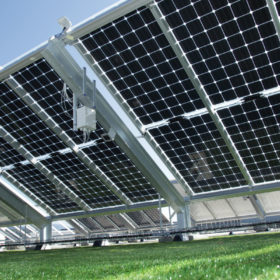
French bifacial standards measure up
A global assessment of bifacial testing methods conducted in Singapore has endorsed the approach taken by France’s Institut National de l’Énergie Solaire.
