
China’s $7 billion consolidation plan may be reflected in prices in short time
China’s reported $7 billion plan to cut polysilicon overcapacity could prompt wafer makers to stockpile lower-cost material and push prices higher, with cell and module suppliers more willing to accept increases, Xin You, senior market analyst at S&P Global, tells pv magazine.

New research shows cast mono wafers are still far from commercial maturity
A Chinese research team has investigated impurity and defect levels in solar cells based on mono cast wafers and have found that around 30% of the devices present an “excessive” reduction in power conversion efficiency. The scientists concluded that cast monocrystalline silicon will unlikely capture a meaningful market share in the near future.

Abandoned US nuclear site to host 16,000 MT polysilicon plant
Highland Materials will build a 16,000 metric ton (MT) solar-grade polysilicon plant on a former US nuclear project site, under a long-term lease with Pivotal Manufacturing.

Is China’s $7 billion plan to reduce polysilicon overcapacity feasible?
OPIS, Wood Mackenzie, and Bernreuter Research have spoken with pv magazine about China’s alleged $7 billion plan to reduce polysilicon oversupply and restore a sustainable pricing environment for the PV supply chain, but opinions remain divided on its feasibility and effectiveness.
Chinese PV Industry Brief: Government targets energy use at polysilicon plants
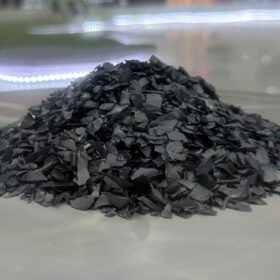
China’s Ministry of Industry and Information Technology (MIIT) has launched a 2025 inspection program targeting energy consumption at 41 major polysilicon producers to curb output.
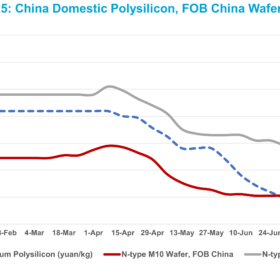
China wafer, polysilicon prices climb 33% since early July
In a new weekly update for pv magazine, OPIS, a Dow Jones company, provides a quick look at the main price trends in the global PV industry.

China poised to remain dominant PV supplier through 2030
New research from Switzerland showed that the recent efforts to counterbalance the dominance of China in the PV industry may lead to “cost-significant” inefficiencies across the entire supply chain. The scientists found, however, that achieving regional supply chain goals can benefit the global PV ecosystem.
How to integrate machine learning in solar cell manufacturing
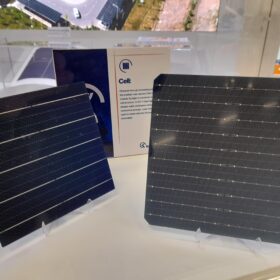
Scientists in Korea have developed a new methodology to employ machine-learning models in “smart” solar cell manufacturing. They utilized data collected from equipment that closely resembles actual industrial manufacturing tools.

Impact of hydrogen on silicon solar cell degradation
German researchers have reviewed recent studies on hydrogen-related degradation in silicon solar cells. They said the work is timely, with n-type silicon dominating production and antimony-doping emerging.
Chinese PV Industry Brief: China passes 1.1 TW of solar despite June slowdown
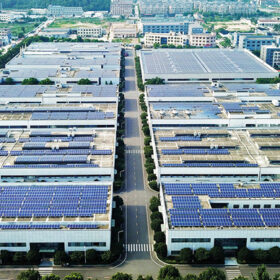
China added 212.2 GW of new solar capacity in the first half of 2025, pushing total installed PV capacity past 1.1 TW, according to the National Energy Administration (NEA).
