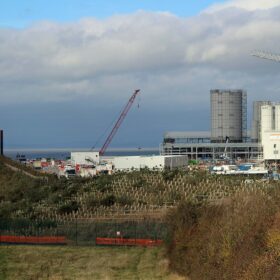
Record nuclear power output in 2024 irrelevant to global energy landscape
Nuclear plants generated a record amount of power in 2024, surpassing record set in 2006, but industry optimism is not backed by economic data or investment, says the World Nuclear Industry Status Report 2025.

Nuclear has highest investment risk; solar shows lowest, say US researchers
Nuclear power plants exceed construction budgets by an average of 102.5%, costing $1.56 billion more than planned, according to a study by Boston University’s Institute for Global Sustainability.

France’s top audit body questions feasibility of EDF’s nuclear plans
France’s Cour des Comptes has issued a warning about rising nuclear energy costs. It is urging state-owned utility EDF to reduce its financial risks in international projects.

Australian renewables to dominate generation in nuclear future
The Australian opposition has released energy plan modeling showing nuclear power could be up to 44% cheaper than current government projections, while forecasting that renewable generation will continue to dominate electricity production.
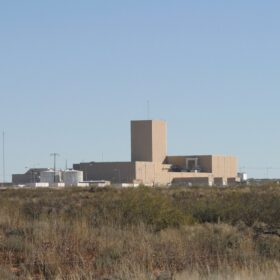
US government nuclear sites going solar
Hecate Energy is working on a 1 GW solar facility at Hanford, a former US nuclear weapons manufacturing site, while NextEra is negotiating to build solar at a nuclear storage facility in New Mexico.

World now has five times more PV than nuclear power
Authors of the World Nuclear Industry Status Report 2024 the world had 408 operational reactors producing 367 GW in the middle of the year, which is significantly less than installed capacity predictions for solar by the end of the year and five time less the world’s cumulative PV capacity, which is now approaching 2 TW.

Israel presents 2050 net-zero roadmap envisaging up to 77% solar share
The Israeli Ministry of Energy and Infrastructure has presented three scenarios for its 2050 green goals, changing in accordance with developments in solar, hydrogen, and nuclear power production. In the most solar-focused scenario, the country would have a PV capacity of 108 GW.
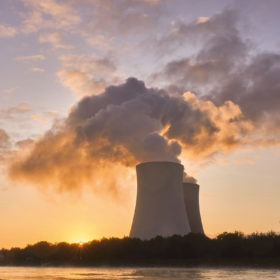
COP28 pledge to expand nuclear capacity is out of touch with reality
While the world noted the Dubai aim of tripling renewables generation capacity by 2030, the controversial summit also saw 25 nations commit to an unofficial pledge to triple nuclear capacity by 2050.
Photovoltaics may increase safety in nuclear power plants
New research from Iran shows that PV installations linked to battery storage may help prevent accidents and increase safety in nuclear power plants by acting as an emergency load. The scientists proposed a system design that considers both technical and economics factors.
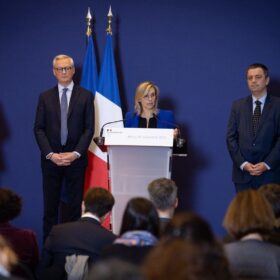
French government, EDF agree on €70 MWh for nuclear power
The French government and EDF have struck a deal on nuclear electricity prices to shield consumers from increases and enable the state-owned utility to fund new reactor construction, drawing criticism from energy-intensive businesses.
