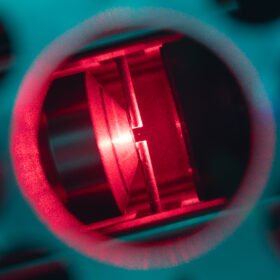
Perovskite-silicon tandem solar cell relying on silica nanospheres achieves 33.15% efficiency
Researchers in China have improved interface engineering in perovskite-silicon solar cells by using industrially textured silicon. The result is a highly efficienct tandem device that also showed remarkable stability.

CEA-INES, WattByWatt achieve 28% efficiency for tandem perovskite-silicon solar cell
France’s CEA-INES and WattByWatt, a Canadian startup, announced a 9 cm2 tandem perovskite-silicon PV cell with an efficiency of 28%, the result of an ongoing research collaboration.

Trina Solar reveals 841 W perovskite-silicon tandem PV module prototype
China’s Trina Solar has unveiled a perovskite‑silicon tandem solar module prototype delivering 841 W and 27.1% efficiency, based on 210 mm tandem cells.
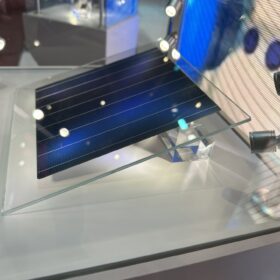
Optimal parameters for perovskite-silicon tandem solar cell manufacturing
Researchers in the Middle East claim to have identified the optimal parameters for the commercial production of perovskite-silicon tandem solar modules across several locations. Their analysis showed that manufacturing costs may currently be as low as $0.387/W, with the prospect of reaching $0.25/W in seven years.
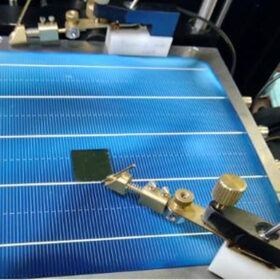
Indian scientists build 29.14%-efficient tandem solar cell with inverted top perovskite device
The researchers said they optimized the low-bandgap inverted perovskite cells through a passivating aluminum oxide (Al2O3) interlayer deposited via atomic layer deposition (ALD), which significantly helped improve device efficiency.

Perovskite-silicon tandem solar cell built with hybrid blade coating achieves 27.8% efficiency
The King Abdullah University of Science and Technology and the Fraunhofer Institute for Solar Energy Systems report producing perovskite-silicon tandem solar cells with open-circuit voltages exceeding 1.9 V as the result of a two-step hybrid evaporated/blade-coated process for perovskite films.

GCL achieves 29.51% efficiency for perovskite-silicon tandem module
GCL Optoelectronics has achieved 29.51% efficiency for its perovskite-silicon tandem solar module, with the result certified by China’s National Institute of Metrology.
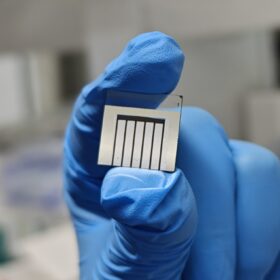
Perovksite-TOPCon tandem solar cell based on self-assembled monolayer achieves 31.1% efficiency
Researchers in China have fabricated a perovskite-TOPCon solar cell with a top perovskite device utilizing a self-assembled monolayer aimed to improved cell stability. The tandem cell achieved a high fill factor and a certified efficiency of 30.9%.
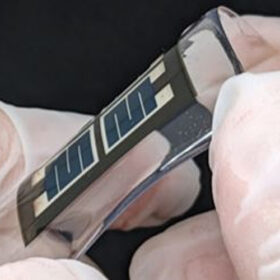
Japanese scientists build bendable perovskite-silicon tandem solar cell with 26.5% efficiency
The tandem device is based on a bottom thin-film heterojunction cell that can bend and a top perovskite cell that can be manufactured with a low-temperature process to prevent damage. It achieved the highest efficiency ever recorded to date for a flexible perovskite-silicon tandem solar cell.

Longi achieves 34.85% efficiency for two-terminal tandem perovskite solar cell
The result was confirmed by the U.S. Department of Energy’s National Renewable Energy Laboratory (NREL).
