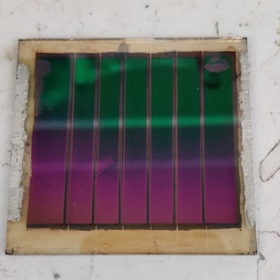
Semi-transparent perovskite solar cell with 13% efficiency, 27% transparency
Developed for applications in BIPV, vehicle-integrated solar and smart glasses, the solar cell was built with an ultra-thin, semi-transparent, triple-cation perovskite film and gold nanorods (Au NRs). The device achieved an open-circuit voltage of 1097.1mV, a short-circuit current of 17.11mA/cm2 and a fill factor of 73.12%.
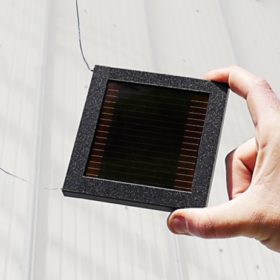
Mini perovskite solar module with 40 sq cm aperture area, 17% efficiency
The 19.2%-efficient perovskite cells used in the module rely on an electron layer based on tin oxide that was deposited via chemical bath deposition. This technique, according to the device’s creators, has made it possible to have a relatively small drop in efficiency from small cells to the 40cm2 module.
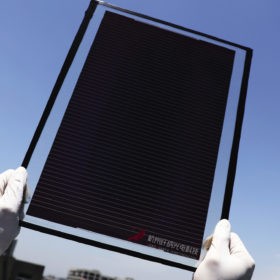
Chinese PV Industry Brief: Microquanta builds 12 MW ground-mounted project with perovskite solar modules
In other news, Haiyuan Material (HYM) said it will commission its 600 MW heterojunction cell factory in July and Polysilicon supplier Daqo announced it is seeking to raise RMB11 billion ($1.74 billion) through a share private placement.
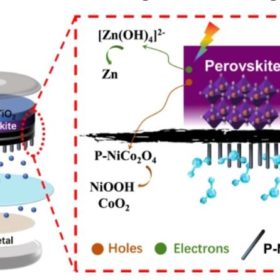
PV-powered rechargeable aqueous zinc battery
Conceived by scientists in China, the device combines an integrated carbon-based perovskite solar cell module with a rechargeable aqueous zinc metal cell. The proposed system achieved an overall efficiency of 6.4%, and a steady operation for more than 200 cycles with little performance degradation.
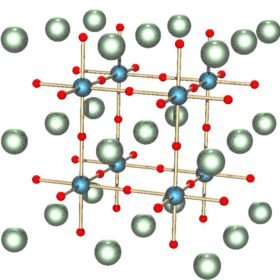
Perovskite solar cell with 24.18% efficiency via low-dimensional perovskitoids
Chinese scientists used perovskitoids as 1D and 0D capping layer materials for the cell’s perovskite layer. These materials enabled an effective and all-around passivation of the perovskite surfaces and grain boundaries, which prevents undesired Shockley-Read-Hall recombination and material degradation. The device achieved a power conversion efficiency of 24.18%, an open-circuit voltage of 1.151 V, a short-circuit current of 25.96 mA/cm2, and fill factor of 80.91%.
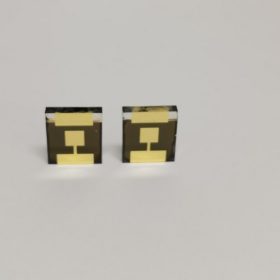
Perovskite solar cell with record-breaking fill factor of 86.6%
An international group of researchers has achieved the highest fill factor reported for perovskite cells of any size to date. The device was fabricated with a nitrogen-doped titanium oxide (TiOxNy) electron transport layer aimed at improving charge transport between the cell’s perovskite absorber and the electrodes.
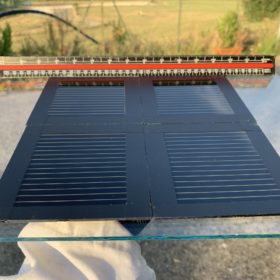
Perovskite solar module with 18.45% efficiency via co-solvent dilution strategy
The module was fabricated with methylammonium lead iodide (MAPbI3) perovskite solar cells via low-cost spin coating. The panel also achieved an open-circuit voltage of 16.07 V, a short-circuit current of 69.52 mA, and a fill factor of 75.35%.
Perovskite solar cell with 1,400-hour stability at high temperatures
German scientists have developed a perovskite PV cell with remarkable stability by adding a bilayer of polymers that protects the perovskite from corrosion. This design helps to shield the extremely sensitive perovskite interface and provides the cell with extraordinarily high conductivity.

Low-cost deposition tech for perovskite solar cells
Italian and Iranian researchers have developed the new “deposition via an antisolvent-soaked applicator” technique, which they describe as an easily scalable process to produce uniform, pinhole-free perovskite films. They tested the process on a 6.7%-efficient solar cell based on a polyethylene terephthalate substrate, raising its power conversion efficiency by 82%.
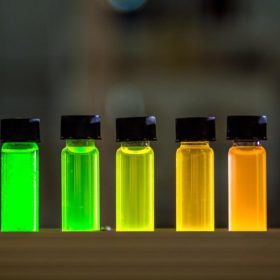
Quantum dot layer pushes perovskite solar cell efficiency up to 25.7%
Researchers in Switzerland have replaced the electron transport layers in perovskite solar cells with a thin layer of quantum dots. On an area of 0.08cm2, they achieved a record efficiency of 25.7% and high operational stability.
