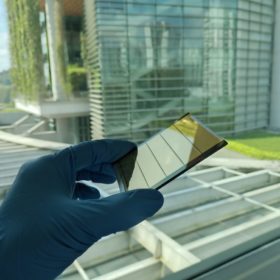
Proper recycling could help perovskite modules to outcompete rivals
Proper recycling strategies for perovskite modules could ensure sustainability and improve energy payback times, according to US researchers. They claim that the best recycled perovskite cell architecture could produce an energy payback time of about one month, versus 1.3 to 2.4 years for crystalline silicon modules.
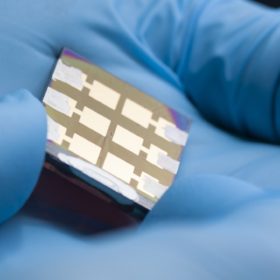
Lead halide perovskite cell based on benzodithiophene cation achieves 14.7% efficiency
Swiss researchers sought for the first time to replace phenylethylammonium (PEA) with benzodithiophene (BDT) in cations for perovskite cells. The latter showed improved stability and ensured a power conversion efficiency that was 1% higher than that of its counterpart.
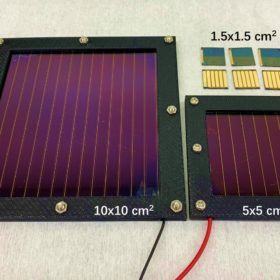
New perovskite material for 23.5%-efficient solar cell
Researchers in Japan have found a new way to fabricate one of the most promising perovskite materials for PV application — the α-formamidinium lead iodide known as α-FAPbI3. With a pre-synthesized version of this material, they were able to produce a cell with a power conversion efficiency of 23.5% and a lifespan of more than 2,000 hours.
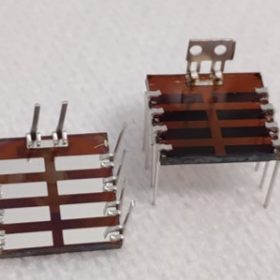
Black perovskite solar cell with 15% efficiency via thermal evaporation
The cell exhibited an open-circuit voltage of 1.1 V and was able to retain around 90% of its initial performance after 215 days of exposure to dim light at room temperature. According to its creators, this performance and the notable stability were ensured by the thermal evaporation technique used for depositing the perovskite layers onto the cell.

Flexible perovskite solar module with 10.5% efficiency
The methylammonium-free inverted solar module was built on a flexible substrate made of polyethylene terephthalate (PET). A hole transporting material made of poly(triarylamine) (PTAA) and a double-cation cesium formamidinium (CsFA) perovskite layer were deposited through blade-coating and nitrogen-assisted blade-coating.

Saule Technologies opens perovskite solar cell factory in Poland
The Polish perovskite solar cell specialist claims to be the first company in the world to have commissioned commercial production of the technology.
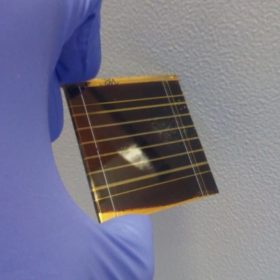
Perovskite solar panel with 16.1% efficiency via ambient air blade-coating
The panel, fabricated by scientists in Italy, is composed of five series-connected cells, each with an area of 2.01 cm² and has an aperture area of 11 cm². It showed a power conversion efficiency of 16.1%, an open-circuit voltage of 5.59 V, a short-circuit current of 37 mA, and a fill factor of 72.5%.
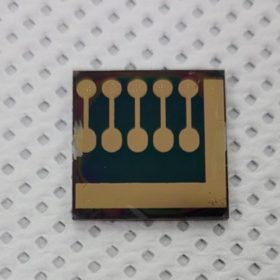
Perovskite solar cell with 19.1% efficiency via CO2 doping
Thanks to a carbon dioxide doping technique, the solar cell interlayers exhibited conductivity around five times higher than that of a perovskite cell based on interlayers doped with oxygen. The device also showed an open-circuit voltage of 1.14 V, a short-circuit current density of 21.2 mA cm2 and a fill factor of 0.79.

CEA-Ines achieves 19.2% efficiency for flexible perovskite solar cell
The cell was fabricated with a flexible substrate made of indium tin oxide (ITO) and polyethylene terephthalate (PET). The device was tested through a damp heat test and showed it can retain around 90% of its initial efficiency after 800 hours.
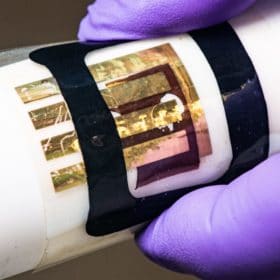
US scientists gain an atom-level view into perovskite cell efficiency
Using Department of Energy laboratories, scientists learned at the atomic level that a liquid-like motion in perovskites may explain how they efficiently produce electric currents.
