
Scientists in China give flexible perovskites a backbone
A team of researchers led by Nanchang University in China trialed a polymer based hole transport layer to flexible perovskite solar cells, using a glue to attach it to the active perovskite. The team was able to assemble the 19.87%-efficient cells into a small flexible module suitable for wearable solar applications, and says its design was inspired by the structure and movements of human vertebrae.
An 18.12%-efficient perovskite solar cell with reduced hysteresis
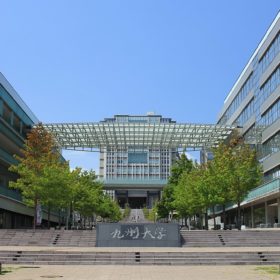
Researchers in Japan have modified the tin(IV) oxide layer of a perovskite device with a fullerene-derivative-based self-assembled monolayer to produce a cell they claim offers stability and a reduction in the hysteresis effect which makes predicting power output so tricky.
Australian scientists claim breakthrough in perovskite stability
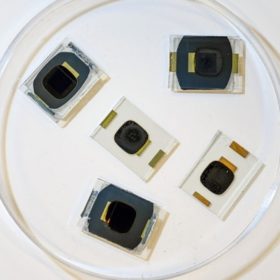
In a world-first, perovskite solar cells developed by Australian scientists have passed a series of heat and humidity tests using a low-cost solution to overcome some of the challenges that are hindering the technology’s commercialization. The scientists did this by suppressing the decomposition of the perovskite cells using a simple, low-cost polymer-glass blanket.

Flexible, 22.6%-efficient perovskite cells for indoor use
The developers of a perovskite device designed for use under illumination of 100-500 lux say it could be manufactured for $78-108 per square meter.
A flexible perovskite solar cell with 11.8% efficiency
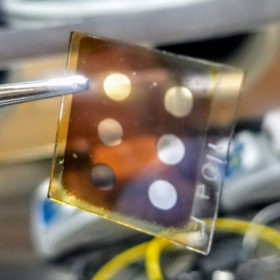
U.S. researchers have created an inorganic mixed halide perovskite solar cell which they claim shows no thermal degradation even at 200 degrees Celsius for three days. The device can be used in tandem junction cells and is designed for use in real-life environments with high solar irradiation.
Mini perovskite module with 18.13% efficiency
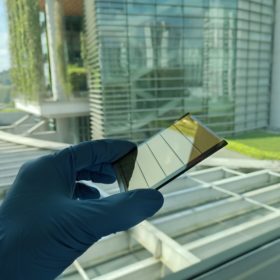
Scientists from Singapore have developed semi-transparent perovskite solar cells that can be easily integrated into a range of urban contexts, including building facades, gates and windows. The 21cm2 mini panels are made of perovskite solar cells based on methylammonium lead iodine (MAPbI3), with an efficiency of 20.28% for 0.16 cm2.

The week in perovskites
As a focus of research at leading institutes the world over, new developments in the perovskite field come thick and fast almost every week. From x-ray observations on a nanoscale to financing and plans for mass production, pv magazine is bringing together some of the most exciting developments of recent weeks.

A new manufacturing process for 19.5% efficient perovskite solar cells
Researchers in China have proposed manufacturing perovskite cells using a pre-nucleation technique. Compared to traditional solvent dripping methods, the approach enables the creation of smaller crystallites in the perovskite films as uncontrolled crystallite growth affects the efficiency and durability of cells.

Achieving 21.2% efficiency in a perovskite cell thanks to food additives
South Korean scientists have developed two perovskite solar cells based on a polymer made with peppermint oil and walnut aroma food additives, respectively. The new dopant‐free hole transport polymer is said to enable longer durability of the devices and to prevent lead-leakage.

Recycling lead-acid batteries for perovskite solar cell manufacturing
Researchers from China are proposing to use spent battery lead for creating a perovskite that can be used in the production of solar cells that are based on this promising material. The proposed one-step process, which was tested in the production of a 17.38% efficient perovskite heterojunction cell, is said to be cheaper and less energy-intensive than other recycling processes for waste lead from lead-acid batteries.
