
Scientists propose manufacturing process to build perovskite solar cells on the Moon
German scientists believe that power generation for future habitats on the moon could be achieved by manufacturing halide perovskite cells locally, using regolith-based moonglass.
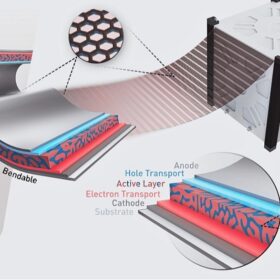
Turkish startup developing perovskite-organic tandem solar cell tech
Spacelis is developing lightweight, rollable space-grade perovskite-organic tandem solar PV technology targeting space and terrestrial portable energy applications.

Alumina oxide nanoparticles extend perovskite solar cell lifetime
Scientists in the U.K. have used alumina oxide in perovskite solar cells to achieve lifetimes exceeding 1,300 h under standards-based heat and humidity testing. Their analysis showed that a reference cell based on conjugated polyelectrolytes degraded in one-tenth the time.
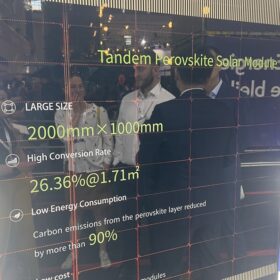
Chinese PV Industry Brief: Kelin Electric to raise funds for 1 GW perovskite project
Kelin Electric says it plans to raise up to CNY 1.46 billion ($201.8 million) through a private placement, with CNY 1.26 billion allocated for a 1 GW perovskite solar module project in Hangzhou, Zhejiang province.
Dutch consortium seeks to reduce costs of hole transport layers for perovskite solar cells
Two Dutch manufacturers have teamed with TNO’s perovskite solar cell experts to integrate spatial atomic layer deposition equipment to produce ultra-thin, high-quality nickel-oxide hole transport layers in a roll-to-roll process. The team targeting production integration in mid-2027, with full-scale production by 2030.
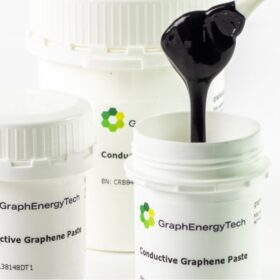
Replacing silver in PV manufacturing with new graphene electrode technology
Swiss-British university spinoff, GraphEnergyTech, is developing graphene electrode technology to replace silver and other metals traditionally used in solar cell manufacturing.

Titanium makes perovskite solar cells more durable
After finding a way to make spiro-OMeTAD, a popular perovskite solar cell hole transport layer, less prone to heat-induced crystallization, researchers at Georgia Institute of Technology are now seeking partners to scale the technology for large-area PV cells.
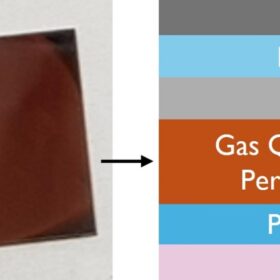
Gas quenching with helium, argon for more stable perovskite solar cells
Kuwait University researchers investigated the relationship between the molecular weight of the quenching gas and the morphology of perovskite films used in solar cells, finding that argon and helium extended device lifetimes compared to using the more conventional nitrogen.
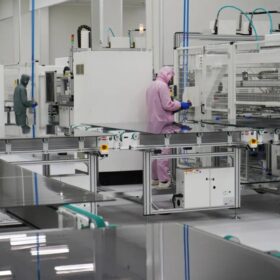
UtmoLight pushes perovksite PV module efficiency to 18.1%
UtmoLight has reached 18.1% efficiency with its perovskite PV modules, according to results confirmed by the US National Renewable Energy Laboratory (NREL).
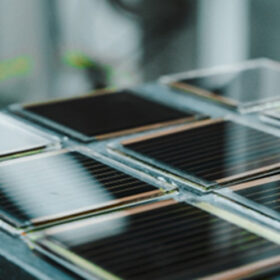
Chinese scientists build 20.3%-efficient mini inverted perovskite solar modules via slot die coating
A team led by University of Electronic Science and Technology of China (UESTC) has found that pyrrodiazole as an additive in formamidinium iodide (FAI)-based inverted perovskite solar enables larger area devices made with industry-compatible slot die coating. Modules made using the technology achieved 20.3% certified power conversion efficiency and retained 94% of initial efficiency after 1,000 h in standard testing.
