
Power Roll developing 12.8%-efficient back-contact perovskite solar devices
Researchers from the U.K.’s University of Sheffield and Power Roll, a perovskite solar PV technology company, have achieved 12.8% power conversion efficiency in indium-free devices based on novel back-contact process. A slot-die coating process was demonstrated, compatible with roll-to-roll manufacturing.

Strategies to reduce perovskite solar cell degradation caused by thermal stress
An international team investigated repeated thermal stress on metal-halide perovskite solar cells and has proposed strategies to boost resistance to degradation effects of diurnal cycles or geographical conditions.
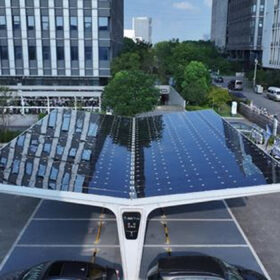
Chinese PV Industry Brief: Renshine Solar working on new perovskite factory
Renshine Solar says it is building a gigawatt-scale perovskite PV module factory in Jiangsu province, with a planned investment of CNY 1.25 billion ($172.4 million). Its perovskite solar panels hit a power conversion efficiency of 18.4% in January 2024.
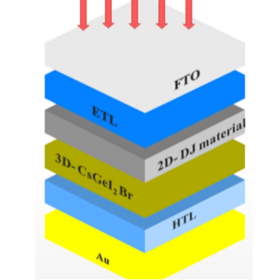
Indian scientists design 31.16%-efficient 2D-3D perovskite solar cell
Scientists in India have simulated a novel perovskite solar cell that combinies a Dion-Jacobson 2D layer with a 3D halide perovskite. The design showed improved stability compared to reference cells without the DJ-2D layer.
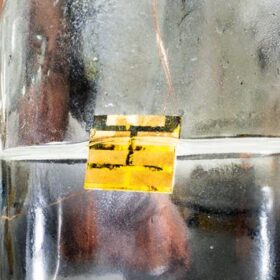
Water-based recycling of perovskite solar cells
An international team has developed a new technique to recycle perovskite solar cells (PSC) made on glass substrates using a water-based solution. Tests showed that the recycled cells were as efficient and stable as the original devices.
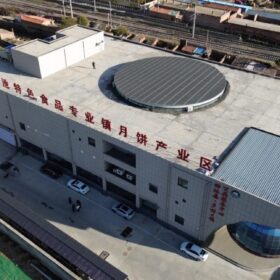
Microquanta developing perovskite solar modules for BIPV applications
The Chinese perovskite solar cell and module maker said its custom-designed double-glass perovskite modules measure 1,200 mm x 1,000 mm and achieve a light transmittance of around 40%.
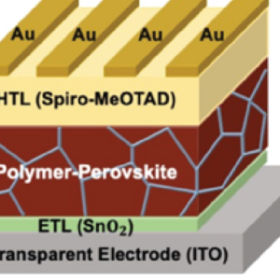
Organic-inorganic perovskite cell relying on furan-based polymer achieves 21.39% efficiency
Researchers in Singapore used a biomass-derived polymer to increase the efficiency of hybrid organic-inorganic perovskite solar cell. The cell was also found to obtain a 90% efficiency retention after 1,100 hours, which compares to 52% for benchmark cells designed without the proposed polymer.
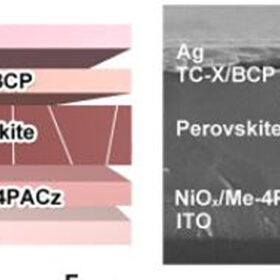
Inverted perovskite solar cell based on stabilized C60 achieves 25.6% efficiency
An international team has utilized an n-type polymeric additive to stabilize C60 molecules for use in inverted perovskite PV cells. Thanks to this approach, the researchers built a solar cell with the highest efficiency value ever recorded for perovskite devices based on solution processed C60 electron transport layers.

Japanese consortium developing lightweight flexible perovskite solar modules
Three Japanese technology companies are testing the durability and performance of lightweight, flexible perovskite solar modules on a pier in Yokohama City. It is part of a larger three year research project underway since late 2023.
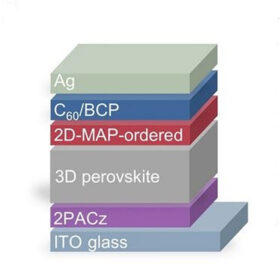
Perovskite solar cell based on 3D/2D heterostructures achieves 26.05% efficiency
Developed by an international team including Saudi Arabia’s KAUST and the Chinese Academy of Science, the solar cell is claimed to be one of the most efficient perovskite PV devices based on 3D/2D heterostructures built to date.
