
Bifacial perovskite solar can achieve bifaciality of 90% when tilted at 20 degrees
New research from India has shown that bifacial perovskite solar cells can achieve a 2% higher power conversion efficiency with a tilt angle of 20 degrees. The scientists also developed a bifacial perovskite solar cell for applications in both tandem or single-junction PV devices.

Chinese developer switches on world’s largest perovskite-based PV plant
MicroQuanta, a Chinese perovskite solar specialist, has commissioned a 8.2 MW PV facility based on its 90 W perovskite panels in eastern China.
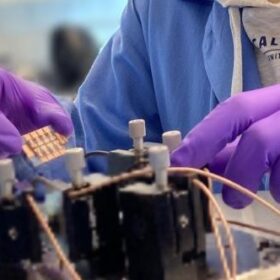
Inverted perovskite solar cell based on amidinium passivator achieves 26.3% efficiency
An international research team has fabricated an inverted perovskite solar cell with an electron transport layer passivated with amidinium ligands instead of ammoniun ligands. The device achived not only a superior performance compared to reference cells treated with ammonium, but also showed remarkable stability.
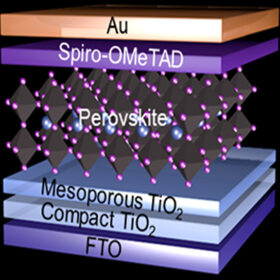
Moisture-resistant perovskite solar cell with 25.14% efficiency
An international research team has fabricated a perovskite solar cell using sulfur-based additives to improve its resistance to moisture. The device not only achieved high efficiency levels but was also able to retain about 96% of its efficiency after 1,000 h.
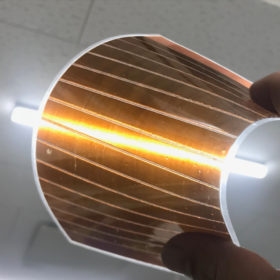
Japan aims to deploy 20 GW of perovskite solar by 2040
The Japanese government says it expects perovskite solar modules to be produced in large quantities at JPY 20 ($0.13)/W by 2025, JPY 14/W by 2030, and JPY 10/W by 2040.
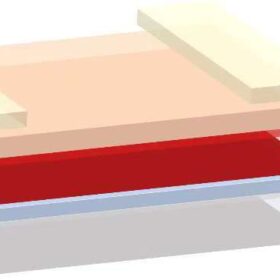
Ultrathin perovskite solar cell based on Gires-Tournois resonator
Scientists in China have conceived a perovskite solar cell that uses a back mirror based on silver to improve light harvesting. The device could reportedly achieved a power conversion efficiency of over 27%.
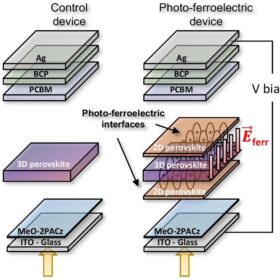
Solar cell based on ferroelectric 2D/3D/2D perovskite junction achieves 24% efficiency
The experimental device achieved an open-circuit voltage of 1.21 V, which is the highest value reported to date for highly efficient perovskite photovoltaics. The cell is based on a photo-ferroelectric 2D/3D/2D perovskite junction integrating a 2D ferroelectric perovskite single crystals in the perovskite bulk.
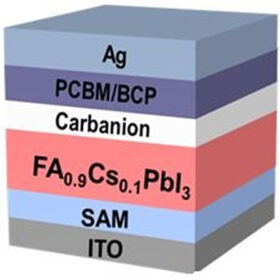
Inverted perovskite solar cell based on lead carbanion achieves 25.16% efficiency
Developed by Scientists in China, the solar cell reportedly achieved the highest open-circuit voltage ever recorded for an inverted perovksite PV device. The lead carbanion layer was responsible for reducing defects at the interface bewteen the perovskite layer and the electron transport layer.
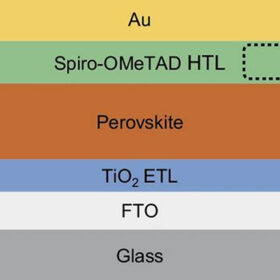
Perovskite solar cell based on lithium salt-doped spiro-OMeTAD achieves 25.45% efficiency
Researchers in China have proposed a new lithium-free doping strategy to fabricate spiro-OMeTAD-based hole transport layers (HTLs) for applications in perovskite solar cell. A PV device built with a salt-doped HTL achieved a record-breaking efficiency of 25.45%.
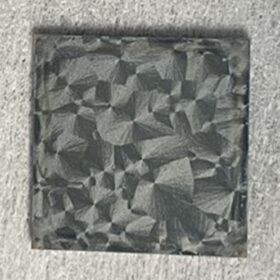
Terpyridine-passivated perovskite solar cells achieve 25.24% efficiency
An international team of researchers demonstrated perovskite solar cells treated with a molecular passivator based on π-conjugated terpyridine Lewis-base molecules that achieved 25.24% power conversion efficiency, with 90% retained after 2,664 hours of light exposure. The treatment reportedly works at high concentrations without damaging the perovskite film or diminishing cell performance. A protocol was published to reproduce the results, opening the door to testing it on a range of perovskite absorbers.
