
China’s Hefei BOE Solar Technology claims 27.37% efficiency for perovskite solar cell
The Chinese perovskite solar technology developer said the result is currently under testing by an unspecified third-party authoritative laboratory in China. The achievement is part of the company’s efforts to bring its perovskite cell technology closer to commercial production.

China National Petroleum Corporation achieves 25.05% efficiency for inverted perovskite solar cell
The Chinese energy and oil company said the cell can be used as a top device in perovksite-silicon tandem configurations. The result was confirmed by the Shanghai Institute of Microsystem and Information Technology (SIMIT).

Perovskite-silicon tandem solar cell with steric complementary design achieves 32.3% efficiency
Researchers in China developed a monolithic perovskite-silicon tandem solar cell using a steric-complementary interface design, achieving a certified efficiency of 32.12% and enhanced long-term stability. This strategy optimizes molecular fit in the perovskite lattice, improving both charge transport and device longevity.

TNO offers mass customization line for integrated PV applications
The Dutch research institute’s highly automated research line offers customized, flexible solar semi-finished PV products to partners developing integrated PV applications.

Building the perfect perovskite, one layer at a time
A University of Cambridge-led team of researchers have demonstrated precisely controlled layer-by-layer epitaxial vapor growth of two-dimensional halide perovskite films in an industrially compatible process. Their findings could help develop more thermally stable perovskite solar cells.
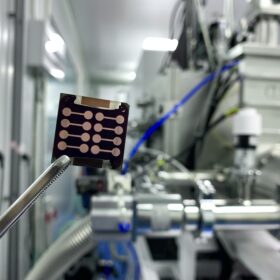
All-perovskite tandem solar cell with dipolar passivation achieves 30.1% efficiency
Researchers in China have developed a dipolar passivation method that reduces defects and improves charge transport in solar cells based on narrow-bandgap tin lead perovskite. The approach has enabled the fabrication of all-perovskite tandem solar cells with efficiencies of around 30% and enhanced stability,

Japan pilots low-weight solar panels, perovskite windows for buildings
Mitsui Home and Tokyo Gas have revealed plans to deploy Japan’s first combined on-site and virtual solar power purchase agreement (PPA), cutting factory emissions and maximizing rooftop energy use.

Perovskite solar cell based on Mxene achieves record-breaking efficiency of 25.75%
A research team in Spain has built what it claims to be the world’s most efficient perovskite solar cell using MXenes or any other type of 2D-materials. The device relies on a Mxene interlayer that suppresses non-radiative recombination and improved charge extraction at the interface between the perovskite absorber and the electron transport layer.

Sharp offers space-qualified solar cells, plans perovskite-silicon tandem production
The Japanese technology company is offering three types of space-grade compound solar cell designs for satellites and spacecraft.

JA Solar builds inverted perovskite solar cell with 26.7% efficiency
The Chinese manufacturer said the cell uses a multifunctional organic ammonium salt to improve interfacial engineering between the perovskite absorber and the electron transport layers. The device also achieved 24.5% efficiency when scaled up to a 1 cm² active area.
