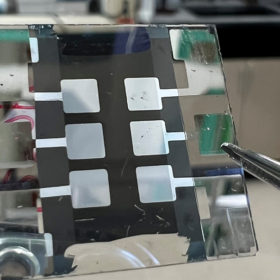
All-perovskite tandem solar cell with 27.1% efficiency via gas quenching
The US National Renewable Energy Laboratory (NREL) has achieved remarkable efficiency and stability for a wide-bandgap all-perovskite tandem solar cell. The scientist developed the device with an inverted architecture and used gas quenching instead of an antisolvent in the manufacturing process.
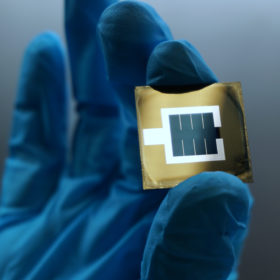
Pathways for perovskite PV
Perovskite solar cells have created excitement in recent years, given their potential to improve virtually every area of PV, but we have yet to see such devices produced at scale. Scientists in Australia have outlined some of the challenges holding them back.
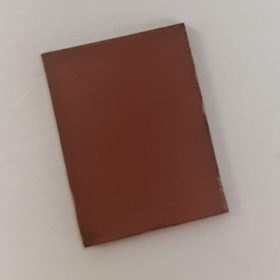
First attempt to build solar cells based on gold polyhalide hybrid perovskite
Scientists in Sweden have proposed the use of gold polyiodide compounds in monolithic perovskite solar cells. They built a lead-free device that achieved an efficiency of 0.052%.
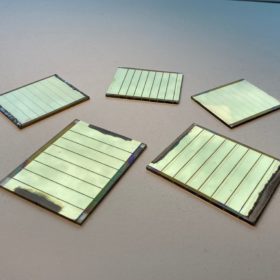
Techniques to build thermally co-evaporated mini perovskite solar panels
Scientists in Singapore have reviewed all thermal evaporation techniques for the production of perovskite solar cells and modules. Despite limitations, the new methods could lead to high production throughputs and more efficient products.
New method brings durability of perovskite solar cells closer to silicon
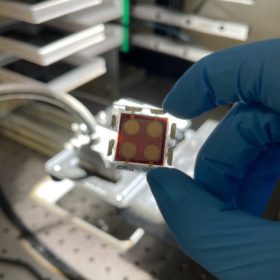
Researchers from the United Kingdom, the United States and Australia have reportedly developed a perovskite solar cell with comparable stability and durability to commercial silicon PV cells. They used a high-temperature processing method with dimethylammonium chloride to control the intermediate phases of perovskite crystallization.
Researchers achieved world record 32.5% efficiency for a perovskite tandem solar cell
A group of researchers from Helmholtz-Zentrum Berlin (HZB) has achieved a new world efficiency record for a silicon-perovskite tandem solar cell, with a certified efficiency of 32.5%.
Meyer Burger to commercialize 29.6%-efficient perovskite tandem solar cells
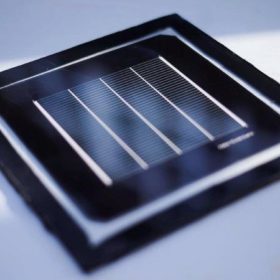
Meyer Burger is working with several research institutes in Switzerland and Germany to integrate perovskite tandem technology into its manufacturing processes.

Australian researchers patent additive for perovskite’s stability problem
University of New South Wales (UNSW) researchers in Australia have discovered a low-cost way to stabilize perovskite solar cells with a triple function additive. Perovskite cells have shown the best stability results with it so far.
Inverted perovskite solar cell with 22.15% efficiency, 83.92% fill factor
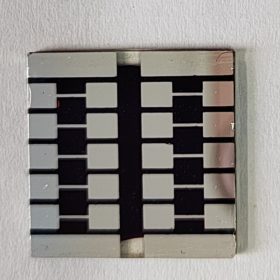
Chinese scientists have used daminozide as an interlayer and additive to make a perovskite solar cell with a p-i-n structure. It has the highest efficiency and highest fill factor for a polycrystalline, MAPbI 3-based inverted perovskite solar cell to date.
Natural-born p-doped material for pervoskite solar cells
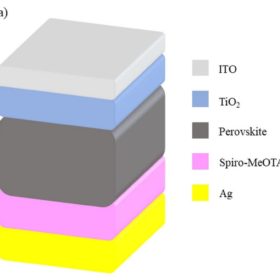
Researchers in South Korea have found that molybdenum ditelluride could increase carrier generation in perovskite solar cells. They simulated a cell with a perovskite absorber and a layer made of the new material, and determined that its efficiency could exceed 20%.
